
T: +86-518-85528012
E: nick@luverrequartz.com
E: nick@luverrequartz.com
1st floor Runlian industrial center No. 116 QuFeng Rd., Haizhou Economic and technological development zone Lianyungang City, Jiangsu Province, China 222062
Views: 0 Author: Site Editor Publish Time: 2026-10-13 Origin: Site


Choosing the right quartz flange requires matching three critical factors: dimensional compatibility with your existing system, material grade appropriate for your temperature and purity requirements, and machining precision that ensures a reliable seal. A quartz flange is not a commodity part—it is a precision component that must integrate with your equipment’s vacuum interface, thermal profile, and chemical environment.

What Is Quartz Flange?
Quartz flange is a fused silica ring or disc welded or machined onto the end of a quartz tube, bell jar, or reaction chamber to provide a sealing surface for vacuum or pressure connections. Unlike metal flanges, quartz flanges offer transparency, extreme thermal stability (up to 1100°C continuous, 1250°C short-term), and chemical inertness that prevents contamination in high-purity processes.
Quartz flanges are typically produced through one of two methods: thermal welding of a prefabricated quartz ring onto a tube, or direct CNC machining from solid quartz plate for smaller or non-tubular configurations. The choice of manufacturing method directly affects the achievable tolerances, lead time, and cost.

Quartz Flange Advantages
Thermal performance: Quartz flanges maintain structural integrity through rapid thermal cycling that would crack borosilicate glass or distort metal components. The low coefficient of thermal expansion (approximately 0.5–0.8 × 10⁻⁶/K) prevents sealing surface deformation during furnace ramp-up and cool-down.
Ultra-high purity: Semiconductor-grade quartz flanges deliver SiO₂ content from 99.9% to 99.999%, with total metal impurity content below 10 ppm. This prevents ion contamination in plasma etching, CVD, and diffusion processes.
Optical transparency: Unlike opaque ceramic flanges, transparent quartz allows direct process observation, UV laser transmission, and in-situ optical monitoring through the flange itself.
Chemical resistance: Quartz resists attack from most acids, alkalis, and corrosive media, including HF solutions at controlled concentrations and temperatures.
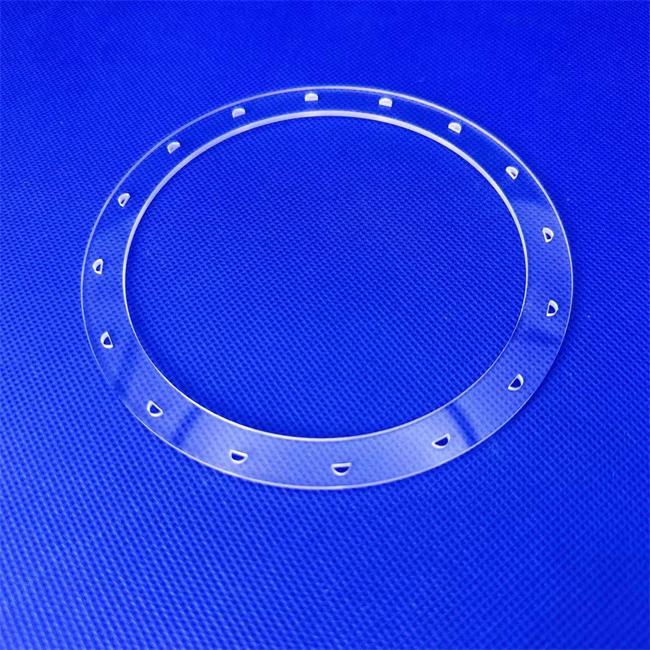
Quartz Flange Applications by Industry
Semiconductor manufacturing: Plasma etch chamber viewports, gas distribution flanges, LPCVD system seals, and wafer inspection windows. Requirements emphasize ultra-low metal contamination and vacuum integrity.
Optical and photonics: Laser cavity flanges, spectrometer windows, and optical bench components. Transparent quartz flanges with >90% transmittance in UV-VIS-IR are standard.
Laboratory and analytical equipment: Reaction cell flanges, high-temperature sample holders, and high-vacuum spectroscopy systems. Custom small-diameter flanges (ID as small as 3mm) are common.
Chemical processing: Corrosion-resistant sight glass flanges and reactor viewport seals for aggressive chemical environments.
Furnace and thermal processing: Bell jar flanges, diffusion furnace end seals, and epitaxy reactor connections.

How to Choose the Right Quartz Flange
Step 1: Determine Flange Size and Connection Standard
The first question is: what are you connecting to? Quartz flanges must match your system’s vacuum interface—typically KF (NW), ISO-K, ISO-F, or CF (ConFlat) standards.
For KF connections, common nominal widths range from DN10 to DN63, with quartz flange outer diameters from 30mm to 87mm depending on the standard. ISO-K flanges for larger systems (DN80–DN160) require correspondingly larger quartz flanges with bolt circle diameters matching the ISO standard.
How to measure your existing connection: Measure the outer diameter of the mating metal flange, the bolt circle diameter, the bolt hole diameter and count, and the inner bore that must align with your tube. If you have a quartz tube already, measure its OD and ID at the open end.
For custom or non-standard connections, send us a drawing or the mating flange itself. We reverse-engineer the interface and produce a quartz flange that fits without modification.
Step 2: Select the Right Quartz Material Grade
Not all quartz is the same. Your application determines which grade is appropriate:
Industrial grade quartz (SiO₂ 99.9%): Suitable for general chemical processing and lower-temperature applications where ultra-low contamination is not critical. Cost-effective for high-volume or non-critical sealing.
Optical grade quartz (SiO₂ 99.99%): Required when the flange serves as a viewing window or must transmit UV-VIS-IR light. Low bubble content achieved through vacuum melting.
Semiconductor grade quartz (SiO₂ 99.999%): Essential for plasma etch, CVD, and diffusion processes. Total metal impurity content below 10 ppm prevents wafer contamination.
Frosted quartz: When you need light diffusion without full transparency—for glare reduction in plasma monitoring or even illumination in optical systems.
Step 3: Specify Surface Finish and Sealing Face Requirements
The sealing face is where your O-ring contacts the quartz flange. Surface roughness directly affects vacuum performance.
For high-vacuum applications (10⁻⁷ mbar and below), specify sealing face flatness of 0.05mm or better and surface roughness (Ra) ≤ 0.4μm. Optical polish or fire polish is recommended.
For standard vacuum and pressure applications, a fine ground finish is often sufficient. The key is consistency—surface defects, chips, or scratches at the sealing face will cause leaks regardless of the overall flatness.
O-ring groove machining: If your design requires a machined groove for the O-ring rather than a flat face seal, specify groove dimensions and tolerances on your drawing. CNC machining achieves groove width and depth tolerances of ±0.05mm or tighter.
Step 4: Define Tolerance Requirements
Quartz machining tolerances differ from metal. Standard achievable tolerances for quartz flanges:
Outer diameter and inner diameter: ±0.1mm standard; ±0.05mm achievable with precision CNC grinding.
Thickness: ±0.1mm standard for machined flanges; tighter on request.
Concentricity (OD to ID): Critical for proper alignment. Specify concentricity tolerance on your drawing—typically 0.1mm for standard applications, 0.05mm for precision sealing.
Bolt circle and hole positions: ±0.1mm typical; ±0.05mm achievable.
Parallelism of sealing faces: 0.05mm typical.
If your application is a replacement part for an existing system, the safest approach is to send the original flange or a detailed drawing with GD&T callouts. We inspect the incoming sample and match critical dimensions.
Step 5: Decide Between Standard and Custom Options
Standard quartz flanges exist for common KF, ISO, and CF sizes. However, most quartz flange applications involve custom dimensions—non-standard tube ODs, unique bolt patterns, or integrated features like stepped bores, threaded holes, or alignment notches.
When to choose custom: Your tube OD/ID doesn’t match a standard flange size; your bolt pattern is non-standard; you need integrated optical windows or masked clear areas; your application requires specific O-ring groove profiles; or you need flanges welded to quartz tubes at precise angles.
Customization capabilities we offer:
- Flange type: flat, raised face, grooved, stepped, custom profile
- Dimensions: OD, ID, thickness, bolt circle, hole size and count
- Surface finish: optical polish, fire polish, fine ground, frosted
- Edge treatment: chamfered, rounded, threaded
- Features: holes, slots, grooves, notches, alignment marks
- Marking: laser-etched part numbers, logos, traceability codes

Custom Quartz Flange Specifications
When requesting a custom quartz flange quotation, provide the following parameters:
Material grade: Industrial, optical, or semiconductor grade; specify SiO₂ purity requirement if contamination-sensitive.
Dimensions: Outer diameter, inner diameter (bore), thickness or height, bolt circle diameter, bolt hole diameter and count.
Sealing interface: Flat face, O-ring groove (specify groove dimensions), or stepped profile. Specify flatness and surface roughness requirements.
Tolerances: Critical dimensions with tolerance callouts. Note which dimensions are functional (affect sealing or fit) versus non-critical.
Surface finish: Specify sealing face finish (polished, ground, frosted) and whether optical transmittance is required.
Quantity: We support low MOQ and prototype orders. A single custom flange for evaluation is acceptable.
Drawings or samples: 2D PDF with dimensions, 3D STEP file, or physical sample for reverse engineering. We produce a prototype for approval before production runs.

Common Problems We Solve
“I can’t find the right size.” Standard flanges rarely match legacy or custom equipment. We machine to your exact dimensions without tooling charges for most sizes.
“My application runs at 1200°C—will the seal hold?” Quartz flanges maintain dimensional stability to 1250°C short-term. We select the appropriate material grade and sealing face finish for your thermal profile.
“I need a non-standard bolt pattern.” CNC machining produces any hole pattern, slot, or notch configuration without additional tooling cost for one-off parts.
“My last supplier’s quality was inconsistent.” We inspect every flange for dimensional accuracy, flatness, and visual defects before shipping. Dimensional inspection reports are available on request.
“I need 5 pieces, not 500.” Low MOQ is standard for custom quartz work. We produce small batches and prototypes as readily as production runs.
“The lead time is too long.” For standard-grade quartz and straightforward geometries, we maintain stock material and fast turnaround. Complex semiconductor-grade parts require material qualification but ship faster than typical industry lead times when drawings are clear.

Frequently Asked Questions
What is quartz flange used for?
Quartz flange provides a sealing and mounting interface on quartz tubes, bell jars, and reaction chambers. It connects quartz components to metal vacuum systems, allows optical access through the flange, and maintains high-purity environments in semiconductor and laboratory equipment.
What is the maximum temperature for a quartz flange?
Transparent fused quartz flanges operate continuously at 1100°C and withstand short-term exposure to 1250°C. Performance depends on the sealing method—O-ring materials may limit the flange sealing temperature below the quartz material limit.
Can quartz flanges be machined with O-ring grooves?
Yes. CNC machining produces precise O-ring grooves with controlled width, depth, and surface finish. Groove tolerances of ±0.05mm are achievable for reliable sealing.
What is the difference between transparent and frosted quartz flanges?
Transparent flanges offer clear visibility and high optical transmittance (>90%) for observation or light transmission. Frosted flanges diffuse light, reducing glare in plasma monitoring applications while maintaining sealing performance.
Can you produce a quartz flange from a sample?
Yes. Send us the original flange or a detailed 3D scan. We reverse-engineer the dimensions and produce a matching part. For critical sealing surfaces, we inspect the sample’s flatness and surface roughness to replicate performance.
What is the typical lead time for custom quartz flanges?
Lead time depends on material grade, complexity, and quantity. Standard industrial-grade flanges with clear drawings typically ship in 15–30 days. Semiconductor-grade parts requiring material certification may take longer. Rush options are available for urgent requirements.
Do you offer low MOQ for custom quartz flanges?
Yes. We support prototype and low-volume orders. A single custom flange for evaluation is acceptable. There is no minimum order quantity for most custom configurations.
How do I know which quartz grade to choose?
Choose industrial grade for general chemical and thermal applications, optical grade for light transmission, and semiconductor grade for plasma or diffusion processes where metal contamination must be below 10 ppm. If you are unsure, describe your process temperature, chemicals, and contamination sensitivity—we will recommend the appropriate grade.
What surface finish is best for vacuum sealing?
High-vacuum applications (below 10⁻⁷ mbar) benefit from sealing face flatness of 0.05mm or better and Ra ≤ 0.4μm. Optical or fire polish reduces outgassing and improves seal reliability.
Can quartz flanges be welded to quartz tubes?
Yes. We produce complete assemblies with flanges thermally welded to quartz tubes, bell jars, and reaction chambers. Welding is performed with oxy-hydrogen torches and controlled cooling to prevent stress cracking.
What tolerances can you achieve on quartz flange machining?
Standard tolerances are ±0.1mm for OD/ID and thickness. Precision CNC grinding achieves ±0.05mm on critical dimensions. Concentricity and parallelism of 0.05mm are achievable.
Do you provide dimensional inspection reports?
Yes. Dimensional inspection reports with measured values for critical dimensions are available on request. For semiconductor-grade parts, we can provide material purity certificates and traceability documentation.
What is the difference between a quartz flange and a quartz window?
Flange provides a mechanical sealing and mounting interface, often with a central bore matching a tube. A window is an optical component designed primarily for light transmission, often with polished faces and specified transmittance. A flange can incorporate a window function if the material is optical grade and the faces are polished.
Can you match the color or appearance of an existing frosted quartz flange?
We control frosting level through the manufacturing process and can produce light, medium, or heavy frost to match your sample. Masked clear areas are also possible when a flange requires both frosted and transparent zones.
How are quartz flanges packaged for international shipping?
Each flange is individually foam-wrapped, placed in a shock-absorbing carton, and packed in a wooden case for export. Cleanroom-compatible packaging is available for semiconductor applications. All shipments include packing lists and dimensional documentation.

Why Choose Us
Source manufacturer with full in-house capabilities. We control quartz material selection, thermal welding, CNC machining, surface finishing, and inspection under one roof. This eliminates the quality gaps that occur when steps are outsourced to different suppliers.
Custom from drawing or sample. Send us a 2D drawing, 3D model, or physical sample. We produce a prototype for your approval before production. No guessing, no surprises.
No MOQ barrier. Low-volume and prototype orders are welcome. We built our business on helping engineers solve problems, not turning away small orders.
Semiconductor and optical grade expertise. We routinely work with 99.999% SiO₂ material, maintain contamination control protocols, and understand the dimensional precision required for plasma and CVD applications.
Fast turnaround on quotations. Send your drawing with dimensions and tolerances. We respond with pricing, lead time, and technical feedback within 24 hours for most inquiries.
Global export experience. We ship to semiconductor fabs, research laboratories, and OEM manufacturers across North America, Europe, and Asia. Export documentation, packing, and logistics are handled in-house.
Quality documentation standard. Dimensional inspection reports, material certificates, and traceability records are available with every order. For critical applications, we provide pre-shipment inspection data for your review.
Quartz flange is a precision fused silica component used to seal and connect quartz tubes and chambers to vacuum systems in semiconductor, optical, and chemical processing equipment. To choose the right flange, match the connection standard (KF, ISO, CF), select the correct quartz grade (industrial, optical, or semiconductor), specify sealing face finish and flatness, and define tolerances for critical dimensions. Custom quartz flanges from source manufacturers support low MOQ, reverse engineering from samples, and rapid turnaround. Key specifications include SiO₂ purity (99.9–99.999%), maximum operating temperature (1100°C continuous, 1250°C short-term), sealing face flatness (0.05mm typical), and surface roughness (Ra ≤ 0.4μm for high-vacuum applications).

Luverre Quartz manufactures and sells a wide range of high quality quartz glass, including quartz tubes, quartz plates, quartz rods, quartz windows, quartz crucibles, quartz boats, quartz flanges, quartz beakers, quartz glass instruments, and more. We can meet all kinds of customized requirements for quartz glass products.
