
T: +86-518-85528012
E: nick@luverrequartz.com
E: nick@luverrequartz.com
1st floor Runlian industrial center No. 116 QuFeng Rd., Haizhou Economic and technological development zone Lianyungang City, Jiangsu Province, China 222062
Views: 0 Author: Site Editor Publish Time: 2026-06-29 Origin: Site


In optical design and industrial applications, wall thickness is a key geometric parameter that affects the light transmittance of quartz tubes. Theoretically, the absorption and reflection losses that occur when light passes through a quartz medium are directly related to the optical path length; an increase in wall thickness means a longer optical path, causing light transmittance to decrease exponentially. Taking high-purity fused quartz tubes in the visible light spectrum as an example, their transmittance typically exceeds 90%. However, when the wall thickness increases from 1 mm to 5 mm, transmittance in the deep ultraviolet spectrum may decrease significantly. This indicates that “wall thickness affects transmittance” is an objective physical law, but the extent of the impact depends on the specific spectral band and application scenario.

In practical applications, our products effectively address the optical challenges posed by variations in wall thickness. Whether it’s ultra-thin walls required for deep-ultraviolet germicidal lamps to ensure high transmittance at 254 nm, or sufficient wall thickness needed for high-temperature tube furnaces to withstand thermal stress, we provide precise custom solutions that strike the optimal balance between mechanical strength and optical performance, thereby preventing reduced equipment efficiency or increased energy consumption caused by improper wall thickness selection.

As a professional manufacturer of custom quartz products, we fully understand the many challenges our customers face under complex operating conditions. We are committed to providing comprehensive customization services—ranging from standard to irregular shapes and from low-hydroxyl to ultra-high-purity quartz—to precisely address challenges such as transmittance decay, high-temperature crystallization deformation, and chemical corrosion. Through strict wall thickness tolerance control (±0.1 mm) and customized material selection, we help you achieve stable and efficient processes in fields such as semiconductors, photovoltaics, and specialty lighting, ensuring that every quartz tube perfectly meets your production needs.

The Key Impact of Wall Thickness on Quartz Tube Light Transmittance
The light transmittance of quartz tubes is influenced by a combination of factors, including material purity, surface treatment, and wall thickness. In the visible light spectrum (380–780 nm), high-quality quartz tubes typically have a transmittance greater than 93%, and variations in wall thickness have a relatively minor effect; however, in the ultraviolet spectrum (185–300 nm), wall thickness plays a critical role. Taking a 10-mm-thick JGS1-grade quartz tube as an example, its transmittance at a wavelength of 185 nm can reach over 85%, while for every 1-mm increase in thickness, UV transmittance decreases by approximately 0.5%. In addition, metallic impurities (such as iron and titanium) can create absorption bands in the UV region, resulting in a 10%–25% reduction in transmittance. Therefore, for applications with extremely high light energy requirements—such as UV sterilization and photochemical reactors—selecting thin-walled quartz tubes with low hydroxyl (OH⁻) content is a key prerequisite for improving system efficiency.

Wall Thickness Selection Strategies for Different Applications
UV Disinfection and Optical Sensing: Thin-Wall Priority
For applications such as low-pressure mercury lamps and UV disinfection lamps, where the operating wavelengths are concentrated at 254 nm or 185 nm, thin-wall quartz tubes with a wall thickness of 1.0 mm–2.0 mm should be selected to minimize absorption losses in the deep-UV band. In these scenarios, high-UV-transmittance quartz tubes (with low hydroxyl content) combined with a thin-wall design ensure that UV transmittance remains above 85%.
High-Temperature Processes and Pressure Vessels: Balancing Strength and Light Transmittance
In high-temperature, high-pressure environments such as semiconductor diffusion furnaces and tube-type heat treatment furnaces, wall thickness must meet mechanical strength requirements, typically ranging from 3 mm to 6 mm. Although light transmittance is somewhat compromised, selecting high-purity quartz raw materials with low bubble content still allows for acceptable transmittance levels in the near-infrared and visible light bands. The key lies in controlling wall thickness uniformity to avoid localized overthickness, which can cause thermal stress concentration and a sudden drop in transmittance.
Solar Thermal Conversion and Solar Energy Utilization: A Comprehensive Consideration
In the field of solar thermal power generation, quartz tubes serve as light-transmitting media; an increase in wall thickness directly reduces light transmission efficiency. Experimental data show that under specific concentrating conditions, the transmittance of quartz glass tubes typically ranges between 92% and 93% and is relatively sensitive to changes in wall thickness. Therefore, such applications require a careful trade-off between structural strength and optical efficiency; in some cases, an anti-reflective coating must be applied to the tube walls to compensate for the additional reflection losses caused by thicker walls.

Full-Range Customization Services: Precisely Tailored to Your Process Challenges
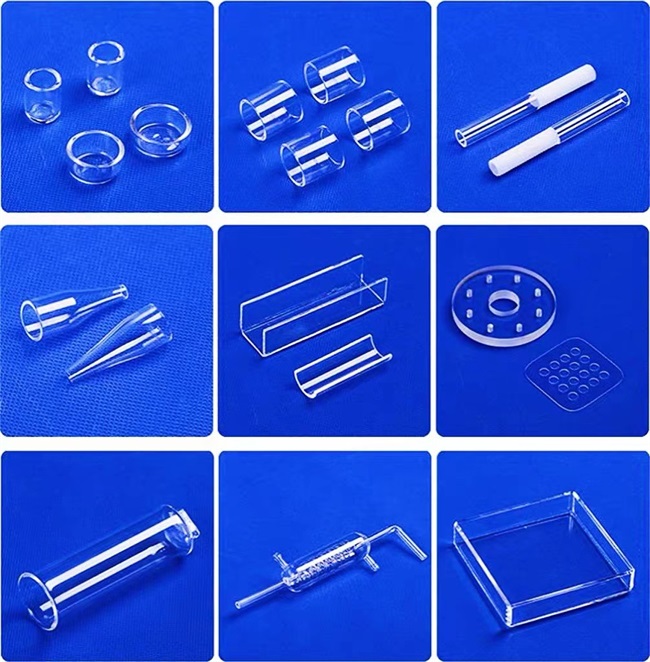
To address technical challenges across various application scenarios, we offer full-range customization services covering outer diameters from 3 mm to 300 mm, wall thicknesses from 0.5 mm to 8 mm, and lengths from 10 mm to 3,000 mm. Whether you require semiconductor-grade dehydroxylated tubes with hydroxyl content below 5 ppm or doped quartz tubes with specialized spectral filtering capabilities, we support custom manufacturing based on your drawings or samples. By providing one-stop services—including cutting, flame-polishing, flaring and reducing, frosting, and custom shaping—we effectively resolve challenges such as poor sealing and thermal stress concentration that users encounter during equipment integration. Strict dimensional tolerances and internal stress relief processes ensure the dimensional stability of quartz tubes in high-temperature environments exceeding 1200°C, significantly reducing the risk of production line downtime caused by material deformation.
Why Choose Us:
We have the production capacity for a full range of quartz tubes with outer diameters from 1.5 mm to 600 mm and wall thicknesses from 0.3 mm to 10 mm. We offer various material options, including transparent continuous-melt, hydroxyl-removed, UV-filtering, and ozone-free quartz. Leveraging high-purity quartz raw materials (SiO₂ content ≥99.99%) and a precise dimensional control system (OD deviation starting at ±0.1 mm, wall thickness deviation ≤12%), we ensure the optical performance of every batch is stable and reliable. More importantly, we offer custom manufacturing based on customer drawings and non-standard processing services, including secondary processing such as cutting, flame-shrinking, end sealing, bending, and frosting.
Customer Application Case: Optimizing Light Transmittance for Photochemical Reactors
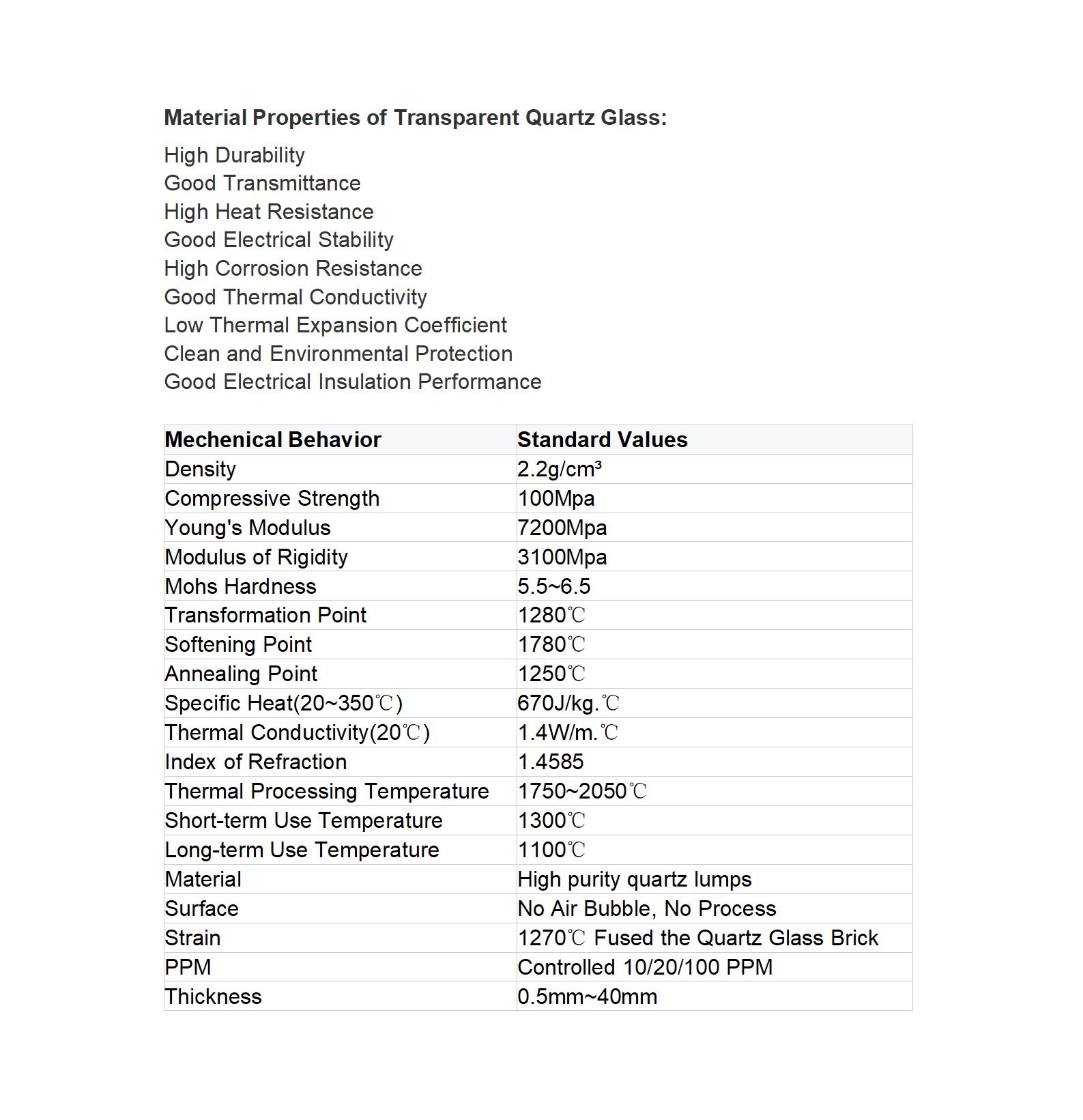
A major environmental technology company faced technical challenges in its industrial-grade UV reactor project: the original thick-walled quartz tubes caused severe attenuation of UV light (254 nm), resulting in low photochemical reaction efficiency. Additionally, after long-term operation, residues tended to adhere to the tube walls, increasing maintenance costs. Upon receiving this request, we custom-designed low-hydroxyl, thin-walled, high-purity quartz tubes for the client. By optimizing the wall thickness design, we increased UV transmittance at the 254 nm wavelength to over 90%. At the same time, by leveraging the extremely low porosity of the quartz surface, we significantly reduced the accumulation of process residues. This solution not only improved the photoreactor’s overall processing efficiency by 30% but also doubled the equipment’s maintenance interval, saving the customer significant operating costs and downtime.
Whether you need to purchase standard-specification products from stock or are facing challenges with non-standard customization for special operating conditions, we are always ready to provide you with professional quartz product solutions. Contact us today to receive a customized solution and free sample testing services!
Luverre Quartz manufactures and sells a wide range of high quality quartz glass, including quartz tubes, quartz plates, quartz rods, quartz windows, quartz crucibles, quartz boats, quartz flanges, quartz beakers, quartz glass instruments, and more. We can meet all kinds of customized requirements for quartz glass products.
