T: +86-518-85528012
E: nick@luverrequartz.com
E: nick@luverrequartz.com
1st floor Runlian industrial center No. 116 QuFeng Rd., Haizhou Economic and technological development zone Lianyungang City, Jiangsu Province, China 222062
Views: 0 Author: Site Editor Publish Time: 2026-10-10 Origin: Site


Quartz Crucible vs Ceramic Crucible: Which One Should You Choose
Choose quartz crucible when you need ultra-high purity (99.99%+ SiO₂), transparency for process monitoring, and excellent thermal shock resistance up to about 1,100°C–1,200°C continuous use. Choose a ceramic crucible (alumina, porcelain, zirconia) when you need higher maximum temperatures, better resistance to alkaline fluxes, or a lower-cost option for general laboratory or industrial melting. The right choice depends on your temperature ceiling, melt chemistry, purity requirements, and heating method — not on which material is universally "better."
What Is Quartz Crucible?
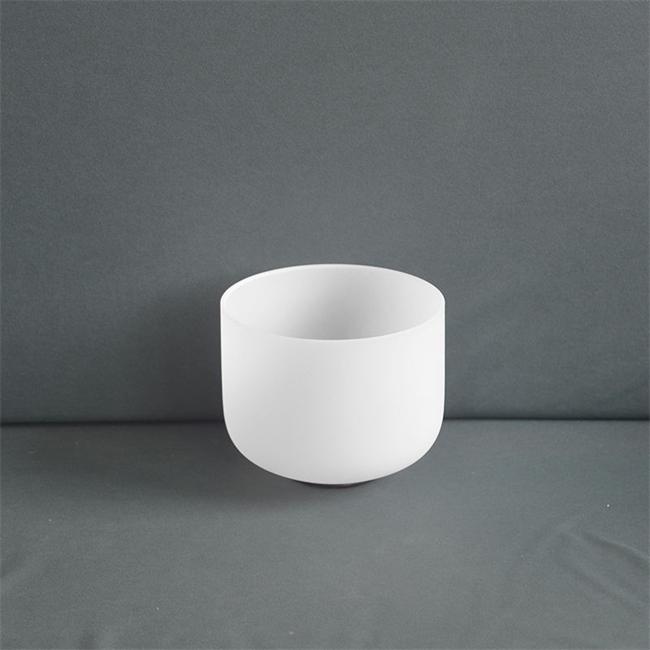
Quartz crucible (also called fused silica crucible) is made from high-purity silicon dioxide (SiO₂ ≥ 99.99%). It is manufactured by melting quartz sand at extremely high temperatures and forming it into cylindrical, conical, or custom shapes.
Quartz crucibles are transparent or opaque. The transparent type allows operators to visually monitor the melting process without opening the furnace — a significant advantage for precision work.
Key properties:
- Purity: 99.99%+ SiO₂, minimal metal contamination
- Maximum continuous use: approximately 1,100°C
- Short-term peak: up to 1,400–1,450°C
- Softening point: approximately 1,730°C
- Thermal expansion coefficient: extremely low (about 0.5 × 10⁻⁶/°C), giving excellent thermal shock resistance
- Chemically inert to most acids (except HF and hot phosphoric acid)
- Reacts with strong alkalis and reactive metals (aluminum, magnesium, titanium)
These characteristics make quartz crucibles the default choice for semiconductor silicon crystal growth, precious metal refining, optical glass melting, and high-purity laboratory analysis.

What Is Ceramic Crucible?
"Ceramic crucible" is a broad category. In industrial and laboratory contexts, it usually refers to alumina (Al₂O₃), porcelain, mullite, or zirconia (ZrO₂) crucibles.
These materials differ significantly from each other, but they share some general traits when compared to quartz:
- Higher maximum temperatures (alumina up to ~1,700°C; zirconia up to ~2,200°C)
- Better resistance to alkaline fluxes than quartz
- Opaque, so no visual process monitoring
- Lower purity than quartz in most grades — though high-purity alumina and zirconia are available
- Wider cost range — porcelain is inexpensive; zirconia is premium
A critical distinction: alumina ceramic crucibles are not the same as fused silica crucibles, even though both are sometimes called "ceramic" in casual usage. Fused silica is technically a glass, not a crystalline ceramic. This matters for thermal shock behavior and chemical compatibility.
Quartz vs Ceramic Crucible: Direct Comparison
Purity (typical): Quartz offers 99.99%+ SiO₂. Alumina ceramic typically ranges from 84–99% Al₂O₃. Zirconia ceramic is usually 97%+ ZrO₂.
Maximum continuous temperature: Quartz handles approximately 1,100°C. Alumina handles roughly 1,600–1,700°C. Zirconia can reach approximately 2,200°C.
Thermal shock resistance: Quartz is excellent. Alumina is fair to good. Zirconia is moderate.
Transparency: Quartz is transparent (clear) or opaque. Both alumina and zirconia are opaque.
Alkali resistance: Quartz is poor. Alumina is good to excellent. Zirconia is excellent.
Acid resistance: Quartz is excellent except against HF. Alumina is good. Zirconia is excellent.
Reactive metal resistance: Quartz is poor. Alumina is good. Zirconia is excellent.
Cost: Quartz is moderate to high. Alumina is low to moderate. Zirconia is high.
Typical use: Quartz serves semiconductors, precious metals, and optical applications. Alumina serves general lab and metallurgy work. Zirconia serves superalloys and reactive metals.

When Should You Choose Quartz Crucible?
Choose quartz when purity is non-negotiable and your process stays within ~1,100°C continuous.
Best applications for quartz crucibles
Semiconductor silicon crystal growth
Quartz crucibles are the industry standard for Czochralski (CZ) silicon pulling. The crucible must introduce zero contaminants into the silicon melt — even trace metal impurities ruin semiconductor performance. These are typically single-use consumables.
Precious metal refining
Gold, silver, and platinum group metals demand clean melting environments. Quartz's chemical inertness and high purity make it ideal for high-end jewelry, bullion, and electronic component manufacturing.
Optical glass and specialty glass melting
Optical glass requires a contamination-free melt to maintain transmission and structural properties. Quartz crucibles provide that clean environment.
Laboratory high-purity analysis
Trace element analysis and small-batch synthesis benefit from quartz's low leaching potential. You also get visual process monitoring.
Quartz crucible limitations to know
- Temperature ceiling: Above ~1,400°C, quartz softens and deforms. It cannot handle superalloy or titanium melting.
- Alkali sensitivity: Sodium hydroxide, potassium hydroxide, and similar fluxes corrode quartz rapidly.
- Reactive metal incompatibility: Aluminum, magnesium, and titanium will reduce SiO₂, contaminating both the melt and destroying the crucible.
- Hydrofluoric acid: Even dilute HF attacks quartz. Avoid entirely.

When Should You Choose Ceramic Crucible?
Choose ceramic when you need higher temperatures, alkali resistance, or cost efficiency for general melting.
Best applications for ceramic crucibles
High-temperature metallurgy (above 1,400°C)
Alumina and zirconia crucibles handle temperatures that would destroy quartz. Zirconia is used for superalloy and reactive metal melting where quartz would fail chemically and thermally.
Alkaline flux melting
Porcelain and alumina crucibles resist sodium carbonate (Na₂CO₃), sodium peroxide (Na₂O₂), and similar alkaline fluxes that attack quartz.
General laboratory ashing and fusion
Porcelain crucibles are inexpensive, chemically adequate for many routine procedures, and rated to ~1,150°C. They are the workhorse of general analytical labs.
Cost-sensitive production
When purity requirements are moderate and the melt chemistry is compatible, ceramic crucibles offer a lower cost per unit than quartz.
Ceramic crucible limitations to know
- Thermal shock sensitivity: Alumina and zirconia can crack under rapid temperature changes. Quartz handles thermal shock far better.
- No visual monitoring: Opaque walls mean you cannot see the melt without opening the furnace.
- Purity variance: Standard ceramic grades contain binders and impurities. High-purity grades cost more.

How to Choose: A Decision Framework
Ask these five questions in order:
1. What is your maximum continuous operating temperature?
- Below 1,100°C → quartz is viable
- Above 1,400°C → ceramic (alumina or zirconia) required
- Between 1,100°C and 1,400°C → depends on duration and melt chemistry
2. Does your melt contain alkalis or reactive metals?
- Yes (NaOH, KOH, Al, Mg, Ti) → ceramic
- No → quartz may work
3. Is contamination a critical concern?
- Yes (semiconductor, optical, trace analysis) → quartz (99.99%+)
- No (general metallurgy, routine lab) → ceramic may be sufficient
4. Do you need to observe the melt?
- Yes → quartz (transparent)
- No → either material
5. What is your heating method?
- Gas/electric resistance furnace → either quartz or ceramic
- Induction furnace → neither works directly; you need graphite or a susceptor setup
Note: Neither quartz nor ceramic crucibles heat by induction directly. They are electrical insulators.

Custom Quartz Crucible Specifications
As a source manufacturer, we produce custom quartz crucibles to your exact requirements. Standard specifications we commonly work with include:
Purity grades: 99.9% to 99.99%+ SiO₂, with low-OH and high-OH options depending on your transmission and thermal requirements.
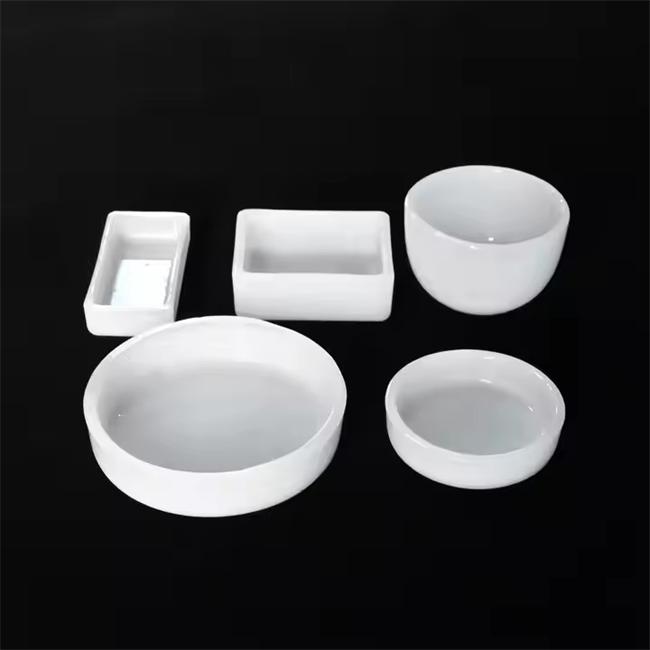
Types: Clear (transparent), opaque (white), cylindrical, conical, round bottom, flat bottom, with or without spout, with or without lid.
Capacity range: 5 mL to 100 L and beyond.
Dimensional ranges: Outer diameter from 15 mm to 600 mm+. Height from 20 mm to 600 mm+. Wall thickness from 1 mm to 10 mm. Bottom thickness from 1 mm to 15 mm.
Surface finish: Fire-polished, smooth, transparent or opaque.
Processing services: Cutting, molding, drilling, grinding, polishing, and full custom dimensions per drawing.
Tolerance capabilities: Precision machining to ±0.1 mm on critical dimensions, depending on geometry.
We support OEM/ODM, build-to-print from DXF/STEP/IGES/PDF, reverse engineering from samples, and prototype-to-production scaling without minimum order quantity restrictions on prototypes.

What Problems We Solve for Crucible Buyers
"I can't find the exact size I need."
Standard catalog sizes never cover every application. We manufacture to your drawing — any diameter, height, wall thickness, or bottom profile.
"My order quantity is too small for most suppliers."
We support single prototypes and low-volume runs. No MOQ on custom prototypes. You don't need to commit to 1,000 pieces to test a design.
"My process runs hot, but not hot enough for alumina."
We help you evaluate whether quartz's temperature ceiling works for your cycle, or whether you need to consider ceramic alternatives. We won't sell you the wrong material.
"I need tight tolerances and clean surfaces."
Our CNC diamond machining and fire-polishing capabilities deliver dimensional precision and low-particulate surfaces for semiconductor and optical applications.
"I'm under time pressure."
Standard catalog crucibles ship in 7–14 days. Custom fabrication typically completes in 3–6 weeks depending on complexity. Quotes within 24 business hours.

Why Choose Us as Your Quartz Crucible Supplier
We are a vertically integrated quartz glass manufacturer based in Lianyungang, China, operating since 2005. Our 15,000 m² facility handles melting, CNC diamond machining, oxy-hydrogen flame forming, and annealing under one roof.
What this means for you:
- Full material control — we melt our own fused silica, so we control purity from raw material to finished part
- Engineering support — direct engineer-to-engineer communication for material selection, DFM feedback, and CAD review
- Flexible order quantities — prototypes through volume production
- Global export experience — 500+ customers across 40+ countries, established logistics and documentation support
- Fast quoting — typically within 24 business hours
We supply not only quartz crucibles but also quartz tubes, plates, rods, flanges, rings, windows, discs, boats, and fully custom quartz assemblies for semiconductor, solar, optical, chemical, and laboratory industries.
Frequently Asked Questions
Can I use a quartz crucible in an induction furnace?
No. Quartz is an electrical insulator and will not heat by induction directly. You need a graphite susceptor or a resistance-heated furnace.
What is the maximum temperature for a quartz crucible?
Continuous use is recommended up to ~1,100°C. Short-term exposure can reach 1,400–1,450°C. Above 1,400°C, quartz begins to soften and deform.
Can quartz crucibles handle thermal shock?
Yes. Quartz has an extremely low thermal expansion coefficient, giving it excellent thermal shock resistance compared to most ceramics. However, it still requires reasonable heating and cooling rates — not infinite shock tolerance.
What melts should NOT go in a quartz crucible?
Alkaline fluxes (NaOH, KOH, Na₂CO₃), reactive metals (Al, Mg, Ti), and anything containing hydrofluoric acid. These attack quartz chemically and will destroy the crucible.
Are quartz crucibles reusable?
In semiconductor silicon growth, quartz crucibles are single-use consumables. In laboratory and lower-temperature applications, reuse may be possible depending on the melt chemistry and thermal cycling. Inspect for devitrification (cloudiness) and cracking before reuse.
What is the difference between clear and opaque quartz crucibles?
Clear (transparent) crucibles allow visual monitoring of the melt. Opaque (white) crucibles provide better thermal insulation and may have a bubble-containing outer layer. Both are made from high-purity fused silica.
Can you manufacture quartz crucibles to my drawing?
Yes. Send us your DXF, STEP, IGES, or PDF drawing. We will review manufacturability, provide DFM feedback if needed, and quote within 24 business hours.
Do you have a minimum order quantity?
No MOQ on custom prototypes. We support single-piece prototype orders and scalable production.
What is the typical lead time?
Standard catalog items: 7–14 days. Custom fabricated crucibles: typically 3–6 weeks depending on geometry and quantity.
Can you match the purity of my current supplier?
We offer 99.9% to 99.99%+ SiO₂ grades. Provide your purity requirement (including trace metal specs) and we will confirm material availability.
Do you provide material certification?
Yes. Certificate of Compliance (CoC) with material traceability documentation is available on request.
How do you package quartz crucibles for shipping?
Inner foam protection with outer wooden case or pallet, designed for safe international transport.
What payment terms do you accept?
T/T, L/C, and other terms negotiable. Contact us for details.
Can you reverse engineer a crucible from a sample?
Yes. Send us the sample, and our engineering team will measure dimensions, identify material grade, and produce a drawing for your approval before manufacturing.
Are quartz crucibles suitable for melting gold?
Yes, if you use a gas or electric resistance furnace and stay within temperature limits. Quartz is commonly used for precious metal refining where purity is critical. Do not use induction heating with a quartz crucible alone.

Quartz crucibles offer ultra-high purity (99.99%+ SiO₂), transparency for process monitoring, and excellent thermal shock resistance for temperatures up to ~1,100°C continuous. They are ideal for semiconductor silicon growth, precious metal refining, and optical glass melting. Ceramic crucibles (alumina, zirconia) handle higher temperatures, resist alkaline fluxes, and cost less for general applications, but are opaque and less pure. Choose quartz for purity-critical, moderate-temperature processes. Choose ceramic for high-temperature or alkali-containing melts. Custom quartz crucibles are available with no MOQ, OEM support, and build-to-print capability.
Luverre Quartz manufactures and sells a wide range of high quality quartz glass, including quartz tubes, quartz plates, quartz rods, quartz windows, quartz crucibles, quartz boats, quartz flanges, quartz beakers, quartz glass instruments, and more. We can meet all kinds of customized requirements for quartz glass products.
