
T: +86-518-85528012
E: nick@luverrequartz.com
E: nick@luverrequartz.com
1st floor Runlian industrial center No. 116 QuFeng Rd., Haizhou Economic and technological development zone Lianyungang City, Jiangsu Province, China 222062
Views: 0 Author: Site Editor Publish Time: 2026-10-23 Origin: Site


Quartz disc is a flat, circular component made from high-purity fused quartz, selected primarily by diameter, thickness, tolerance grade, surface finish, and application environment. Getting the specification right the first time prevents rework, reduces lead time risk, and ensures the part performs reliably in high-temperature, optical, or contamination-sensitive processes.
This guide is written for procurement managers, engineers, and OEM manufacturers who need to move from a vague requirement (“we need a quartz disc”) to a manufacturable specification. It covers the key decision points, the trade-offs that affect cost and delivery, and the practical questions to ask a supplier before placing an order.

What Is a Quartz Disc and Why Material Purity Matters
Quartz disc is a precision flat round part fabricated from fused quartz (SiO₂), offering high thermal shock resistance, broad optical transmission, and excellent chemical inertness. The material grade determines whether the disc is suitable for semiconductor, optical, or general industrial use.
Fused quartz discs are typically specified with purity levels of 99.9% SiO₂ or higher. For semiconductor and optical applications, trace impurity control is critical: alkali ions (sodium, potassium) can migrate under thermal stress and contaminate process environments. High-purity grades minimize this risk and also reduce bubble content and OH content, which affect optical performance in the UV range.
Key material properties that drive disc selection include:
Thermal performance: Fused quartz offers continuous use temperatures in the 1100–1400°C range, with short-term excursions possible higher depending on grade and thickness. The low coefficient of thermal expansion (approximately 0.54 × 10⁻⁶/K) means a quartz disc resists thermal shock far better than most ceramics or glass-ceramics.
Optical transmission: Standard fused quartz transmits well from the deep UV through the near-infrared, typically covering roughly 180–2500 nm depending on grade and thickness. For UV-transparent applications, specify low-OH or UV-grade material; for IR work beyond 2.5 µm, confirm the grade’s transmission curve before committing.
Chemical resistance: Quartz discs resist most acids and solvents, with the notable exception of hydrofluoric acid and hot phosphoric acid. This makes them suitable for wet chemical processing and labware, provided the chemistry is verified.

Quartz Disc Applications: Where Discs Are Actually Used
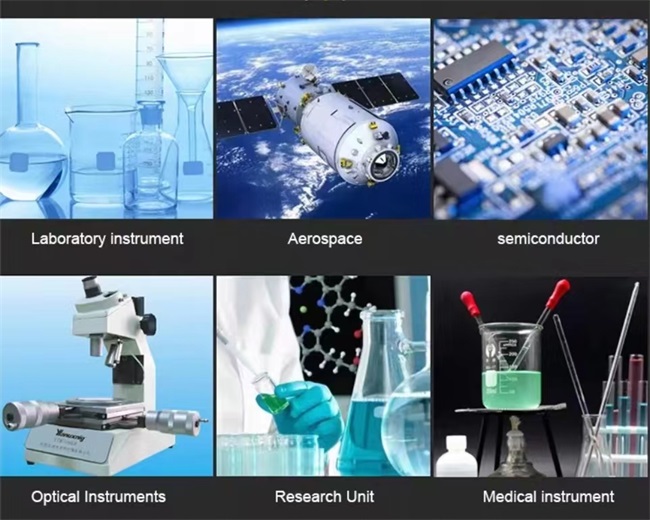
Quartz discs appear in four main application families: semiconductor process components, optical windows and substrates, high-temperature furnace hardware, and laboratory/analytical equipment. Each application imposes different priorities on the specification.
Semiconductor and thin-film processing. Quartz discs serve as wafer support components, viewport windows, purge plates, and insulating spacers in deposition and etch tools. Here, particle generation and metallic contamination are the dominant concerns. Surface finish and edge quality matter as much as bulk purity: a poorly finished edge sheds particles with every thermal cycle.
Optical and photonics systems. Quartz discs function as protective windows, substrates for coatings, and transmission elements in UV lithography, spectroscopy, and laser systems. The specification must address transmission range, surface flatness, parallelism, and scratch/dig quality. A disc that is dimensionally correct but optically flawed will fail in these roles.
High-temperature furnace and reactor hardware. Quartz discs are used as baffles, radiation shields, sample platforms, and insulating washers in diffusion furnaces, CVD reactors, and high-temperature test rigs. Thermal cycling resistance and dimensional stability under load are the primary selection criteria.
Laboratory and analytical equipment. Quartz discs appear as sample supports, window seals, and crucible covers in ICP-MS, TGA, and digestion systems. Here, chemical inertness and low blank contribution are often more important than extreme tolerance precision.
How to Specify Quartz Disc Size and Diameter
Diameter selection is driven by the mating component or clear aperture, not by convenience. Specify the diameter with an explicit tolerance, because quartz disc diameter tolerance directly affects fit, sealing, and cost. A typical commercial tolerance might be ±0.5 mm for a catalog disc, but precision-machined discs can hold far tighter tolerances depending on the supplier’s capability and the edge geometry required.
Start with the functional requirement: Is the disc sitting inside a bore, covering an opening, or being clamped between flanges? For bore-fit applications, specify the diameter and the required clearance or interference. For window applications, the clear aperture is the critical dimension; the outer diameter only needs to be large enough to seal.
Avoid over-specifying diameter tolerance “just to be safe.” Tightening diameter tolerance without a functional reason adds machining time and inspection cost, and it can complicate sourcing when you need a quick replacement. A ±0.1 mm tolerance is achievable on precision-ground discs; ±0.01 mm or better requires lapping and more careful metrology, which affects lead time.
Large-diameter discs introduce additional considerations: thickness uniformity, flatness after thermal cycling, and handling risk. If your application requires a disc above roughly 200 mm diameter, discuss the flatness specification with the supplier early, because flatness is harder to hold as diameter increases.

Choosing the Right Thickness
Thickness is a structural and thermal decision. The minimum thickness is set by the pressure differential, clamping load, thermal gradient, and the need to avoid fracture during handling. The maximum thickness is usually limited by weight, thermal mass, and optical transmission requirements. There is no universal “correct” thickness; a 3 mm disc that works as a protective window may be dangerously thin as a furnace baffle.
For window and optical applications, thickness affects transmission and flatness. A thicker disc is stiffer and easier to polish flat, but it absorbs more light in the UV and adds weight. Thin discs (1–3 mm) are common for viewports and substrates; thicker discs (6 mm and above) are used where mechanical rigidity or sealing pressure demands it.
For high-temperature structural applications, thickness must account for thermal gradients. A disc clamped at its edge and heated from one face develops a bending moment; too thin a disc will warp or crack. As a starting point, structural quartz discs in furnace service are often 5–15 mm thick, but this must be validated against the actual thermal cycle and support geometry.
For semiconductor consumable components, thickness tolerances are often tighter than diameter tolerances because the disc may sit in a pocket or act as a spacer. Specify thickness with a tolerance that reflects the assembly stack-up, not an arbitrary number.

Machining and Surface Finish: What You Can and Cannot Compromise
Machining quality determines whether a quartz disc performs as a precision component or merely as a piece of glass. Edges, flatness, parallelism, and surface finish are the four machining characteristics that most often cause field failures. Quartz is hard and brittle; it cannot be machined like metal. Grinding, lapping, and polishing are the standard processes, and each adds cost and lead time.
Edge quality. A ground edge with a controlled bevel or chamfer reduces chipping risk during handling and thermal cycling. For semiconductor and vacuum applications, edge chips are a contamination source and must be specified—typically by reference to an accepted standard or a visual acceptance criterion agreed with the supplier. “Smooth to the touch” is not a specification.
Flatness and parallelism. For optical and sealing applications, flatness may be specified in wavelengths (for optical-grade) or in micrometers (for mechanical-grade). Parallelism between the two faces matters for windows that must maintain optical alignment and for discs that clamp against a flat surface. A disc that is flat on one face but wedge-shaped will leak or distort.
Surface finish. Polished surfaces are required for optical transmission and for cleanliness in semiconductor environments. Ground or lapped finishes are acceptable for structural and furnace hardware where optical clarity is irrelevant. Specify scratch/dig quality for optical discs; specify roughness (Ra) or visual criteria for non-optical discs.
Holes, slots, and contours. A quartz disc does not have to remain a simple round flat part. CNC-machined quartz discs can incorporate bores, counterbores, slots, and non-circular outlines, provided the drawing accounts for quartz’s brittleness and the tooling required. Small deep holes in thin discs are high-risk features; discuss them with the fabricator before finalizing the design.

Custom Quartz Disc Specifications: What to Send to a Supplier
A complete custom quartz disc inquiry includes the material grade, drawing or sample, critical dimensions with tolerances, surface finish requirements, quantity, and the application environment. Suppliers who receive this information upfront can quote accurately and flag manufacturing risks before production begins.
The essential specification package includes:
Material grade: Specify purity level, OH content (if optical), and any visible bubble/ inclusion limits. If you do not know the grade, describe the application—temperature, chemistry, optical range—and ask the supplier to recommend.
Drawing or sample: A 2D drawing with dimensions and tolerances is the baseline. For complex contours, provide a DXF, STEP, or PDF with the profile defined. If you have an existing part that works, a sample is often the fastest path to a correct quote, because the supplier can reverse-engineer the critical features.
Critical-to-function dimensions: Mark which tolerances actually matter. A disc with ten dimensions does not need all ten held to ±0.02 mm. Identifying the sealing diameter, the flatness of the working face, and the thickness at the clamp zone allows the supplier to allocate machining effort where it affects performance.
Surface and edge requirements: State whether the disc is optical, sealing, or structural. Specify edge chip acceptance, scratch/dig, and whether polishing is required on one or both faces.
Quantity and delivery: Small-batch custom quartz discs are a common pain point in the industry. Many distributors only stock catalog sizes; many large fabricators prefer high-volume runs. A manufacturer set up for flexible production can handle prototype quantities and production scale without forcing you into a minimum order that exceeds your actual demand.
Application notes: Temperature range, thermal cycling profile, chemical exposure, vacuum or pressure differential, and cleaning method. These details allow the fabricator to recommend the right grade and flag design issues—for example, a sharp internal corner that will act as a crack initiation site under thermal load.

Common Selection Mistakes and How to Avoid Them
The most common quartz disc selection errors are over-tolerancing, under-specifying edge quality, ignoring thermal expansion mismatch with mating materials, and choosing a supplier based on price alone without verifying process control. Each of these mistakes is predictable and avoidable.
Over-tolerancing occurs when a drawing carries tight tolerances on every dimension “because precision is good.” In quartz machining, tight tolerance equals time and cost. A disc that needs ±0.05 mm on diameter and ±0.1 mm on thickness should not carry ±0.01 mm on both unless the function demands it.
Under-specifying edges is the opposite problem. Buyers often focus on faces and ignore the edge, which is where chips originate. A chipped edge on a furnace disc becomes a particle source; on a vacuum window, it becomes a leak path or a fracture origin. Define edge quality explicitly.
Ignoring thermal expansion mismatch is common when quartz discs mate with metal flanges or ceramic supports. Quartz expands very little compared to most metals. If the disc is clamped rigidly at high temperature, the metal grows more than the quartz, and the disc cracks. The solution is often a compliant mounting design or a different clamping strategy, not a different disc.
Price-only sourcing is tempting when the part looks simple. But quartz discs are deceptively process-sensitive. A supplier without controlled grinding, cleaning, and inspection can deliver parts that look correct and fail in service. Ask about process control, measurement capability, and how edge chips and surface defects are judged.
Frequently Asked Questions
What is the difference between a quartz disc and a fused silica disc?
In commercial usage, the terms are often used interchangeably. Technically, fused silica refers to synthetic or high-purity fused quartz with very low OH and metallic content, while “quartz” can describe natural quartz-derived fused material. For specification purposes, state the purity and OH requirements rather than relying on the name alone.
Can you manufacture quartz discs to my drawing?
Yes. Custom machining from customer drawings is a standard capability. Provide a dimensioned drawing with tolerances and critical features identified. For complex profiles, a DXF or STEP file accelerates quoting.
What is the maximum diameter you can produce?
Capability varies by supplier and thickness. Large-diameter discs require thicker stock and more careful flatness control. As a general guide, discs in the 200–300 mm range are routinely machined; larger sizes should be discussed with the fabricator to confirm stock availability and flatness capability.
What thickness tolerance can you hold?
Precision-ground quartz discs can typically hold thickness tolerances in the ±0.05 mm to ±0.1 mm range, with tighter tolerances possible by lapping depending on diameter and quantity. Specify the functional requirement and let the supplier propose the process.
Do you polish both faces?
Polishing can be applied to one or both faces. For optical windows, both faces are usually polished. For structural or sealing discs, a ground or fine-ground finish may be sufficient and more economical.
Can quartz discs withstand direct flame or rapid heating?
Fused quartz has excellent thermal shock resistance, but it is not indestructible. Rapid heating or cooling of a constrained disc can generate stresses that exceed the material’s strength, particularly at edges and around holes. The safe heating rate depends on thickness, mounting, and temperature differential; this should be validated for your specific geometry.
Are quartz discs suitable for vacuum applications?
Yes, provided the disc is specified correctly. Vacuum windows require attention to flatness, surface finish, and edge quality. The pressure differential creates tensile stress on the atmospheric side; thickness must be adequate for the diameter and pressure.
What is the typical lead time for a custom quartz disc?
Lead time depends on complexity, quantity, and material availability. Simple ground discs in common sizes can ship in weeks; polished optical discs with tight flatness and custom contours take longer. A supplier with in-house machining and flexible scheduling can often compress lead time for urgent requirements.
Do you offer low minimum order quantities?
Yes. Flexible production models allow small-batch and prototype orders without forcing customers into large inventory commitments. This is particularly relevant for engineers validating a design or procurement teams managing spares for legacy equipment.
Can you match a sample part we already have?
Yes. Sample-based manufacturing is a practical route when drawings are unavailable or incomplete. The supplier measures the sample, identifies critical dimensions and features, and produces a drawing for approval before machining.
What cleaning process is used before shipment?
Cleaning depends on the application. Standard cleaning removes machining residue and handling contamination. For semiconductor and high-purity applications, additional cleaning and packaging controls may be specified. Discuss your cleanliness requirements at the inquiry stage.
How do you control quality on custom discs?
Quality control typically includes incoming material verification, in-process dimensional checks, final inspection against the drawing, and visual inspection for chips and surface defects. The specific inspection plan should be agreed before production, especially for critical-to-function dimensions.
Can quartz discs be coated?
Yes, quartz discs can be coated with anti-reflective, reflective, or filter coatings for optical applications. Coating adds process steps and should be specified with the optical requirements (wavelength range, incidence angle, environmental durability).
What information do you need for a fast quote?
Material grade (or application description), drawing or sample, quantity, required delivery date, and any critical inspection or cleanliness requirements. Missing information on tolerances and edge quality is the most common cause of quote delays.
Do you export internationally?
Yes. Export experience matters for documentation, packaging, and logistics. Confirm that the supplier routinely ships to your region and can provide the required commercial invoices, packing lists, and material certificates.
Why Choose Us for Custom Quartz Discs
We solve the specification-to-delivery gap that buyers and engineers face when a standard catalog disc will not fit, when tolerances are tighter than a distributor can hold, or when the required quantity is too small for a high-volume fabricator. Our production model is built around custom quartz components, not around pushing catalog stock.
Drawing-based and sample-based manufacturing. Send a drawing with tolerances, or send a sample that works. We measure, confirm critical features, and produce to the agreed specification. You are not forced to choose between an oversized catalog disc and a long tooling lead time.
Flexible quantities. Prototype runs and small-batch orders are accepted without punitive minimums. This matters for design validation, spares management, and equipment builders who need a handful of discs rather than a pallet.
High-purity material selection. We source and machine quartz grades appropriate to the application—semiconductor, optical, or general high-temperature—and provide material documentation on request. If you are unsure which grade fits your process, describe the temperature, chemistry, and optical requirements and we will recommend a starting point.
Precision machining with practical tolerances. Diameter, thickness, flatness, parallelism, edge profile, and surface finish are controlled to the drawing. We flag features that are likely to cause yield loss or delivery risk before production begins, so you can adjust the design if needed rather than discovering the problem at inspection.
Global export experience. Packaging, documentation, and shipping are handled for international destinations. Quartz is fragile and contamination-sensitive; the packaging must protect both the part and the cleanliness of the part.
If you are currently sourcing a quartz disc and facing a fit problem, a tolerance problem, a small-quantity problem, or a lead-time problem, send the drawing or sample details for a technical review and quotation.
Quartz disc selection depends on five variables: diameter with functional tolerance, thickness driven by structural and thermal load, material grade matched to purity and optical requirements, machining quality (especially edges and flatness), and supplier flexibility for custom quantities. A correct specification defines critical-to-function dimensions rather than tolerancing every dimension tightly. Custom quartz disc manufacturers bridge the gap between catalog limitations and production-scale minimums by accepting drawing-based and sample-based orders, holding tolerances appropriate to the application, and controlling edge quality and surface finish as specified. Buyers should provide the material grade or application details, a dimensioned drawing or sample, quantity, and delivery requirements to receive an accurate and manufacturable quotation.

Luverre Quartz manufactures and sells a wide range of high quality quartz glass, including quartz tubes, quartz plates, quartz rods, quartz windows, quartz crucibles, quartz boats, quartz flanges, quartz beakers, quartz glass instruments, and more. We can meet all kinds of customized requirements for quartz glass products.
