
T: +86-518-85528012
E: nick@luverrequartz.com
E: nick@luverrequartz.com
1st floor Runlian industrial center No. 116 QuFeng Rd., Haizhou Economic and technological development zone Lianyungang City, Jiangsu Province, China 222062
Views: 0 Author: Site Editor Publish Time: 2026-10-15 Origin: Site


Quartz Flanges for Vacuum & High Temperature | Custom Manufacturer
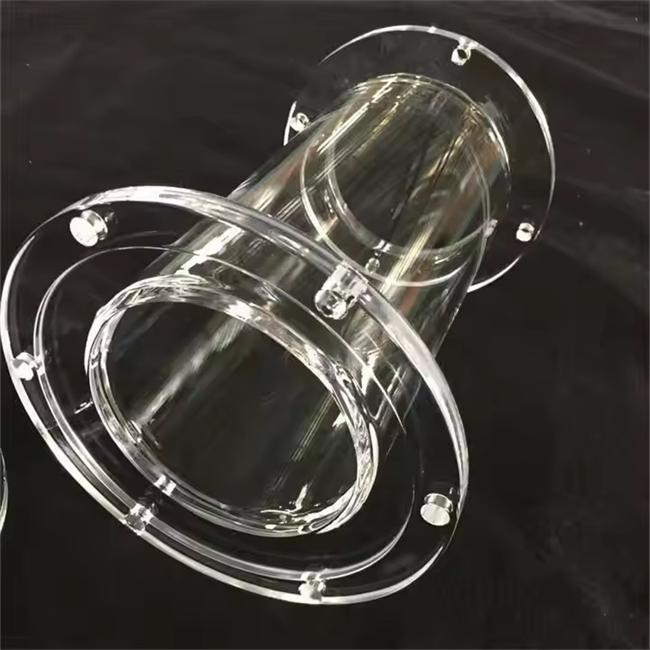
Quartz flanges for vacuum and high-temperature applications are precision-machined fused silica components that provide reliable sealing, structural integrity, and optical access in extreme environments where metals and borosilicate glass fall short. They serve as critical interfaces in semiconductor process chambers, vacuum viewports, high-temperature furnaces, and chemical reactors—applications that demand thermal stability up to 1000°C or higher, vacuum integrity down to 10⁻⁹ mbar, and resistance to thermal shock and chemical corrosion.
What Are Quartz Flanges?
Quartz flanges are fused silica (amorphous SiO₂) components machined with flat or profiled sealing surfaces that connect quartz tubes, chambers, viewports, and piping in vacuum or high-temperature systems. Unlike standard borosilicate flanges, quartz flanges offer significantly higher thermal limits—up to 1000°C continuous use compared to borosilicate's 450°C maximum.
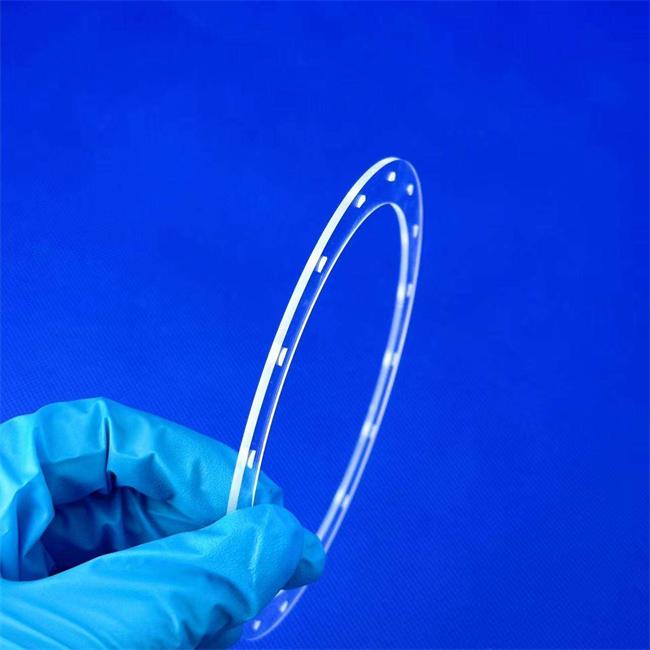
The sealing mechanism typically involves an O-ring compressed between the quartz flange face and a mating metal flange, with a centering ring or clamp holding the assembly. For UHV applications, metal gasket seals or specialized polymer seals are used. Quartz flanges can be fabricated as blank flanges (solid discs), viewport flanges (with an optical window), or machined with bolt holes, grooves, and alignment features to match existing equipment interfaces.
Why Choose Quartz Flanges Over Alternative Materials?
Quartz flanges outperform borosilicate glass, ceramics, and metals in combined thermal, optical, and chemical requirements.
Fused quartz offers a maximum continuous use temperature of 1000–1100°C, while borosilicate glass is limited to approximately 450°C and stainless steel begins to oxidize around 800°C. This temperature advantage alone makes quartz the preferred choice for furnace and semiconductor applications.
The thermal expansion coefficient of fused quartz is approximately 0.5–0.8 × 10⁻⁶/K between 20°C and 300°C. Borosilicate expands at roughly 3.3 × 10⁻⁶/K, and stainless steel at about 16 × 10⁻⁶/K. This near-zero expansion means quartz flanges undergo minimal dimensional change during rapid heating or cooling cycles—critical for maintaining seal integrity in processes like semiconductor diffusion and rapid thermal annealing.
In terms of UV transmission, fused quartz transmits more than 90% of UV light, while borosilicate has a UV cutoff and stainless steel is completely opaque. This makes quartz flanges essential for UV lithography, excimer laser delivery, and spectroscopy applications.
For vacuum capability, quartz flanges with appropriate sealing can reach 10⁻⁹ mbar. Borosilicate typically limits at 10⁻⁷ mbar, while stainless steel can achieve 10⁻⊃1;⊃1; mbar but cannot provide optical access or high-temperature operation without oxidation.
Chemically, quartz is inert to most acids (except hydrofluoric acid) and offers high resistance to corrosion. Borosilicate and stainless steel both show moderate chemical resistance depending on the specific medium.
Finally, quartz offers excellent thermal shock resistance due to its low expansion, while borosilicate is good and stainless steel is poor.

Key Applications Across Industries
Quartz flanges are essential wherever processes combine vacuum, high temperature, and the need for optical access or chemical inertness.
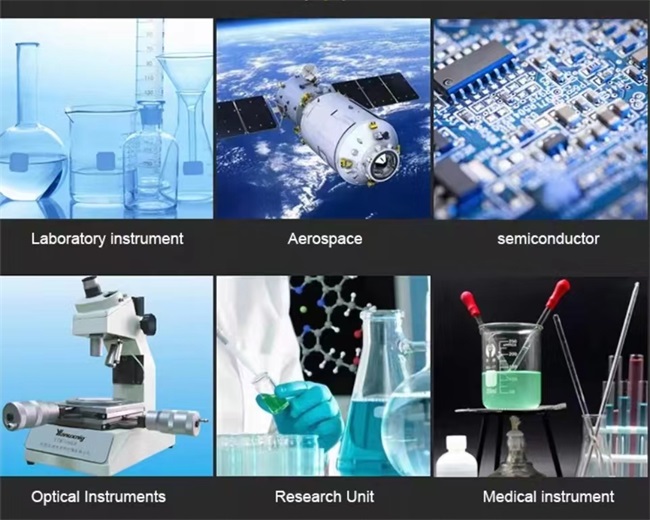
In semiconductor fabrication, process chambers operating at 800°C or higher require quartz flanges that maintain vacuum seal integrity without contaminating wafers. Quartz flanges are used in plasma etch chambers, LPCVD systems, ion implanters, and oxidation furnaces.
In optical and laser systems, viewport flanges machined from optical-grade quartz transmit UV, visible, and IR light for process monitoring, laser delivery, and spectroscopy. Fused silica's low UV absorption makes it preferred over borosilicate for excimer laser and UV lithography applications.
For high-temperature furnaces, quartz flanges serve as viewing ports, gas inlet and outlet interfaces, and tube-to-chamber connections. The 1000°C+ temperature rating allows direct placement in hot zones where metal flanges would degrade.
In chemical processing, quartz flanges resist attack from most acids and corrosive media (with the exception of hydrofluoric acid). This makes them suitable for reactors, wet benches, and exhaust systems in aggressive chemical environments.
For research and laboratory use, custom quartz flanges serve as reaction cell windows, sample holder interfaces, and vacuum feedthrough ports in analytical instruments and experimental apparatus.
How to Select the Right Quartz Flange
Selecting the correct quartz flange requires matching the material grade, sealing configuration, and dimensional tolerances to your specific operating conditions.
Step 1: Determine the Temperature and Vacuum Requirements
For continuous operation above 800°C, specify high-purity fused quartz rather than borosilicate. For UHV applications below 10⁻⁷ mbar, verify that the flange flatness and surface finish meet the sealing method's requirements. Typically, 0.05 mm flatness is sufficient for O-ring seals.
Step 2: Choose the Sealing Interface
The three common sealing configurations are O-ring seal with centering ring, metal gasket seal, and direct weld or fused connection.
For O-ring seals with centering rings, standard KF/NW connections use a compressible O-ring positioned by a centering ring. Quartz flanges for KF interfaces must match the standard NW dimensions for the size, such as NW16, NW25, NW40, and NW50.
For metal gasket seals, UHV or high-temperature sealing uses metal gaskets made of copper or aluminum with knife-edge or flat sealing surfaces.
For direct weld or fused connections, some furnace applications use a quartz flange flame-welded directly to a quartz tube for a permanent, leak-free joint.
Step 3: Specify the Optical Requirements
If the flange functions as a viewport, the material grade and surface finish determine optical performance. Industrial-grade quartz offers basic transparency. Optical-grade or semiconductor-grade quartz provides higher transmission, lower bubble content, and tighter wavefront distortion specifications. Specify surface quality using scratch-dig standards if imaging or laser transmission is critical.
Step 4: Verify Chemical Compatibility
Quartz resists most acids but is attacked by hydrofluoric acid and hot concentrated alkalis. If your process involves these chemicals, consider alternative materials or protective coatings.

Custom Quartz Flange Specifications
We manufacture quartz flanges to your exact drawing, sample, or functional specification. Below are the parameters we routinely customize.
Material Grades
Industrial grade with SiO₂ ≥ 99.9%, optical grade with high transmission and low bubble content, and semiconductor grade with low OH and low metallic impurities (less than 30 ppm OH).
Dimensional Range
Outer diameters from 10 mm to 300 mm and beyond. Inner diameters and bore dimensions machined to your specification. Thickness from 2 mm to 50 mm depending on pressure and sealing requirements.
Tolerances
Standard machining tolerance is ±0.1 mm. Tighter tolerances are available for critical sealing dimensions. Flatness of sealing faces is typically 0.05 mm or better on request.
Surface Finishes
Ground, fire-polished, or optical-polished sealing faces. Optical surfaces can be specified to scratch-dig standards such as 20/10 or 40/20, with controlled transmitted wavefront distortion.
Features and Modifications
Bolt holes, threaded holes, O-ring grooves, alignment pins, step profiles, counterbores, chamfers, and edge treatments. We also integrate flanges with tubes, windows, and multi-port assemblies.
Flange Standards
KF/NW from NW10 through NW50, ISO-K, ISO-F, and custom proprietary interfaces. We manufacture to match your existing equipment or provide engineering support if you need help defining the interface.

Quartz Flange Manufacturing Advantages
Working with a direct quartz manufacturer eliminates the compromises inherent in sourcing from distributors or general glass fabricators.
Drawing-Based Production. Send your CAD files in DXF, STEP, IGES, or PDF format, or simply send a physical sample. Our engineering team reviews for manufacturability and quotes within 24 business hours.
Low MOQ or No MOQ. Prototype single pieces and scale to production volumes without tooling charges or minimum order penalties. This is especially valuable for R&D projects and obsolete equipment replacement parts.
Precision Machining. CNC diamond grinding, drilling, and milling produce sealing faces with the flatness and finish required for reliable vacuum performance. Optical polishing is available for viewport flanges.
High-Purity Material Control. We source from qualified quartz suppliers and maintain material traceability. Semiconductor-grade quartz with controlled OH content and low metallic impurities is available for contamination-sensitive processes.
Fast Turnaround. Standard lead times are 7–14 days for simple flanges and 3–6 weeks for complex custom geometry. Expedited options are available for urgent requirements.
Global Export Experience. We ship to customers in more than 40 countries with appropriate packaging for fragile quartz components, including foam-wrapped, shock-absorbing cartons and wooden cases.

Frequently Asked Questions
What is the maximum operating temperature of a quartz flange?
Fused quartz flanges can operate continuously at 1000–1100°C and handle short-term excursions up to 1250°C. Devitrification, or crystallization, becomes a concern above 1100°C in the presence of water vapor or surface contamination.
What vacuum level can quartz flanges achieve?
With proper sealing using O-rings or metal gaskets, quartz flanges support vacuum down to 10⁻⁹ mbar or better, depending on the flange design and sealing method.
Can quartz flanges be used with standard KF/NW clamps and centering rings?
Yes. We manufacture quartz flanges to standard NW/KF dimensions including NW16, NW25, NW40, and NW50, so they mate with standard centering rings and clamps. Note that some sources recommend plastic clamps rather than metal for certain viewport applications to avoid stress concentrations.
What is the difference between quartz and borosilicate flanges?
Quartz flanges offer roughly double the temperature capability, superior UV transmission, and lower thermal expansion. Borosilicate costs less and is adequate for lower-temperature applications where UV transmission is not needed.
Do you support custom dimensions and non-standard bolt patterns?
Yes. We machine to your drawing, including custom outer and inner diameters, bolt circles, hole sizes, and sealing face profiles. No standard catalog constraint applies.
Can you match a quartz flange to an existing metal flange?
Yes. Send us the mating flange drawing or a sample, and we will reverse-engineer the quartz flange to match the interface, including bolt pattern and sealing face geometry.
What information do you need for a quote?
A drawing or sketch with critical dimensions, material grade preference, quantity, and any surface finish or tolerance requirements. If you only have a sample, we can measure and quote from that.
What is your minimum order quantity?
We support no-MOQ production for prototypes and small batches. Production volumes of any size are welcome.
How do you package quartz flanges for international shipping?
Each flange is foam-wrapped, placed in a shock-absorbing carton, and packed in a wooden case or pallet. Cleanroom-compatible packaging is available for semiconductor applications.
Can quartz flanges be repaired if damaged?
Minor surface damage on sealing faces may be re-polished. Major cracks or chips typically require replacement. We can assess damaged parts and advise on repair feasibility.
Do you offer optical-grade quartz for viewport flanges?
Yes. We supply optical-grade and semiconductor-grade fused silica with specified transmission, bubble class, and surface quality for viewport and laser applications.
What is the typical lead time?
Standard flanges take 7–14 days. Custom geometry takes 3–6 weeks. Expedited production is available depending on capacity.
Can you produce quartz flanges with integrated tubes or windows?
Yes. We manufacture flanged tube assemblies, viewport flanges with sealed optical windows, and multi-port flange structures as integrated quartz components.
What surface finish is needed for a vacuum seal?
For O-ring seals, a ground or fine-machined finish with flatness of approximately 0.05 mm is typically sufficient. Metal gasket seals require finer surface finishes and tighter flatness. We can advise based on your sealing method.
Do you provide material certifications?
Yes. Material certificates, dimensional inspection reports, and surface finish documentation are available on request.

Why Choose Us for Quartz Flanges
We solve the procurement problems that standard suppliers cannot address.
The problem: "I can't find the size I need." We machine to your drawing. No catalog limitation.
The problem: "Non-standard products are too difficult to source." Custom geometry is our standard workflow, not an exception.
The problem: "My process runs too hot for borosilicate." Quartz flanges rated to 1000°C and above.
The problem: "The tolerances are critical for my vacuum seal." Precision CNC machining with flatness verification.
The problem: "My lead time is too short for a custom order." Expedited production options and efficient engineering review.
The problem: "I only need a small quantity for a prototype." Low MOQ or no MOQ.
The problem: "I've had quality inconsistencies from other suppliers." Material traceability, dimensional inspection, and stable production processes.
Whether you need a single replacement flange for a discontinued furnace or a production run of custom viewport flanges for an OEM equipment line, we have the material capability, machining precision, and export experience to deliver.
Quartz flanges for vacuum and high-temperature applications are precision-machined fused silica components used in semiconductor chambers, furnaces, viewports, and chemical reactors. They operate continuously at 1000–1100°C, achieve vacuum levels down to 10⁻⁹ mbar, and transmit over 90% of UV light. Selection depends on temperature, vacuum level, sealing method, optical requirements, and chemical compatibility. Custom manufacturing supports drawing-based production, low or no MOQ, high-purity material grades, and fast global delivery for non-standard sizes and urgent lead times.
Ready to discuss your quartz flange requirement? Send your drawing, sample, or specification for a quote within 24 business hours.
Luverre Quartz manufactures and sells a wide range of high quality quartz glass, including quartz tubes, quartz plates, quartz rods, quartz windows, quartz crucibles, quartz boats, quartz flanges, quartz beakers, quartz glass instruments, and more. We can meet all kinds of customized requirements for quartz glass products.
