T: +86-518-85528012
E: nick@luverrequartz.com
E: nick@luverrequartz.com
1st floor Runlian industrial center No. 116 QuFeng Rd., Haizhou Economic and technological development zone Lianyungang City, Jiangsu Province, China 222062
Views: 0 Author: Site Editor Publish Time: 2026-08-14 Origin: Site


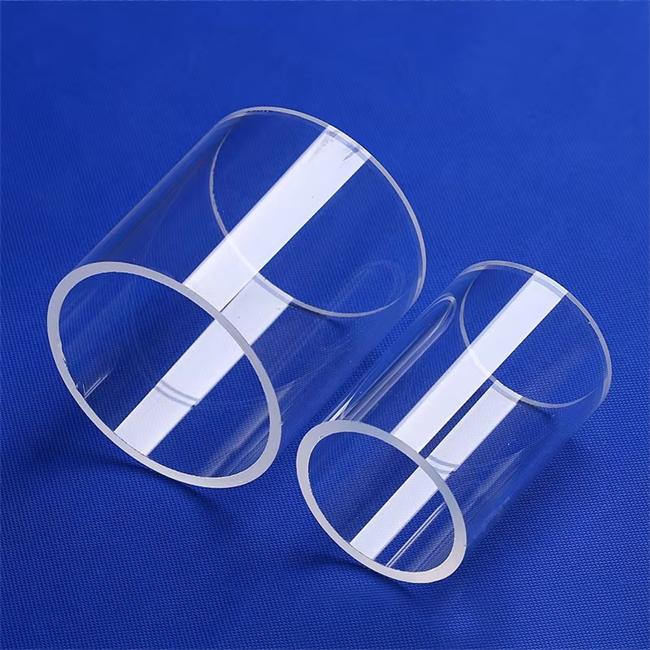
When your application involves rapid temperature changes exceeding 200°C in seconds, most materials fail. Quartz glass doesn't.
This guide answers the critical question procurement managers and engineers ask daily: How does quartz glass perform under thermal shock, and can it solve my high-temperature application challenges?
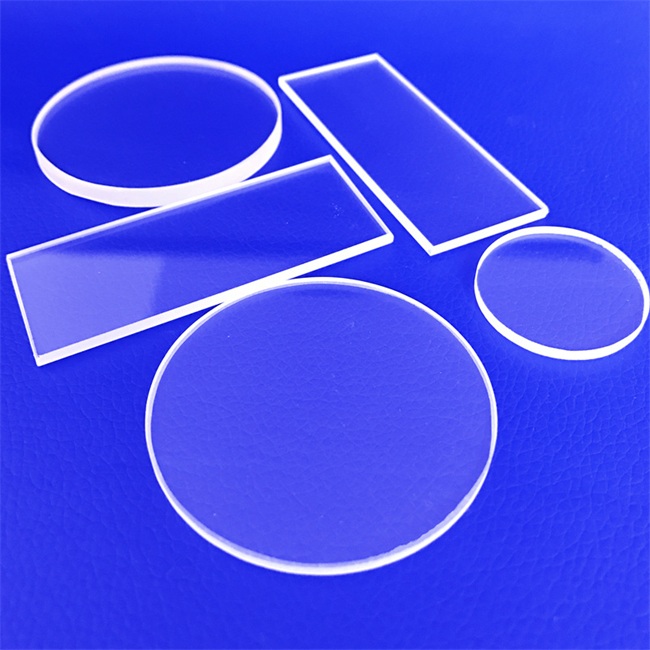
What Is Thermal Shock Resistance in Quartz Glass?
Quartz glass offers exceptional thermal shock resistance, withstanding sudden temperature differentials of over 1000°C (from 1100°C to room temperature in seconds) without cracking or structural failure. This performance stems from its extremely low coefficient of thermal expansion (CTE)—approximately 0.5–0.65 × 10⁻⁶/°C, roughly 1/10 to 1/20 that of ordinary glass.
Why Quartz Glass Survives Thermal Shock
The secret lies in the amorphous (non-crystalline) structure of fused silica. Unlike crystalline materials that expand and contract unevenly when heated or cooled, quartz glass maintains a near-constant volume across temperature changes. The strong Si-O bonds that form its molecular backbone provide both structural integrity and minimal expansion.
Key thermal properties that enable thermal shock resistance:
- Coefficient of Thermal Expansion (CTE): 0.5–0.65 × 10⁻⁶/°C (over the 20–1000°C range)
- Continuous Operating Temperature: 1100–1160°C
- Short-Term Maximum Temperature: up to 1450°C
- Softening Point: approximately 1710–1730°C
- Annealing Point: approximately 1220–1250°C
- Strain Point: approximately 1120–1125°C
- Thermal Conductivity at 20°C: 1.38–1.5 W/mK; this increases to about 2.68 W/mK at 950°C
Real-World Thermal Shock Performance
Quartz glass can be heated to 1100°C and immediately plunged into cold water without cracking. This capability makes it invaluable for:
- Rapid thermal processing (RTP) equipment in semiconductor manufacturing
- Laboratory furnaces undergoing fast heating/cooling cycles
- Chemical reactors where temperature swings are routine
- Optical systems exposed to sudden heat sources
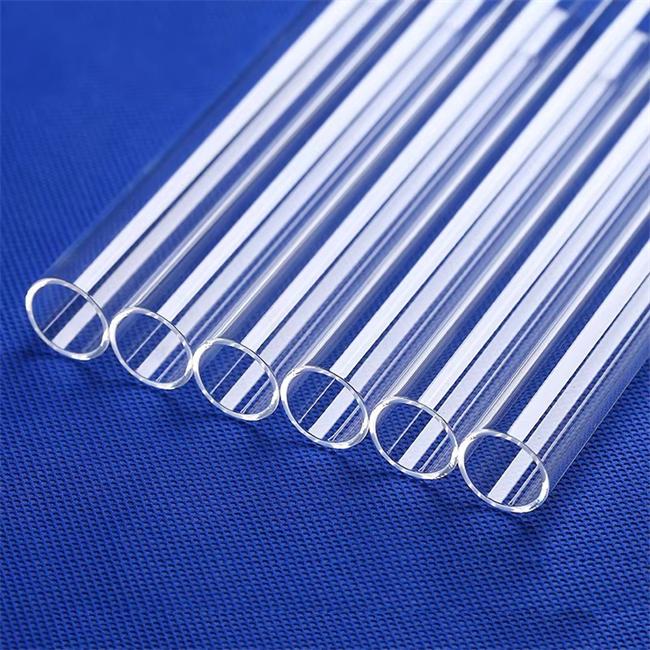
What Makes Quartz Glass Thermally Shock Resistant?
The combination of ultralow thermal expansion, high-purity SiO₂ composition (typically >99.9%), and the amorphous molecular structure gives quartz glass its unparalleled resistance to thermal shock. Purity directly correlates with performance—higher purity means more consistent expansion behavior and fewer defect sites where cracks could initiate.
The Science Behind the Performance
1. Low Thermal Expansion Coefficient — When heated, most materials expand. Uneven expansion creates internal stresses that cause cracking. Quartz glass expands so minimally (5.5 × 10⁻⁷ cm/cm·°C) that thermal stress remains below the material's fracture threshold even during rapid temperature changes.
2. High Softening Point — With a softening point of approximately 1710°C, quartz glass maintains its shape and mechanical properties at temperatures that would cause borosilicate or soda-lime glass to deform.
3. Homogeneity — The amorphous structure lacks grain boundaries or crystalline inclusions that could serve as stress concentration points during thermal cycling.
Comparison: Quartz Glass vs. Other Glasses
- Quartz Glass — CTE of 0.5–0.65 × 10⁻⁶/°C, maximum operating temperature of 1100–1160°C, and exceptional thermal shock resistance.
- Borosilicate Glass — CTE of approximately 3.3 × 10⁻⁶/°C, maximum operating temperature around 500°C, and good thermal shock resistance.
- Soda-Lime Glass — CTE of approximately 9.0 × 10⁻⁶/°C, maximum operating temperature around 400°C, and poor thermal shock resistance.
What Thermal Shock-Related Problems Can Quartz Glass Solve?
Quartz glass thermal shock resistance solves five critical pain points: (1) equipment failure during rapid heating/cooling cycles, (2) contamination from cracked or spalled furnace components, (3) production downtime from frequent part replacement, (4) inability to achieve consistent results in temperature-sensitive processes, and (5) high maintenance costs associated with thermally damaged components.
Common Application Challenges Addressed
- Rapid Thermal Processing (RTP) — Semiconductor furnaces cycle from room temperature to over 1000°C in seconds. Standard materials fracture; quartz glass handles these conditions reliably.
- Quenching Operations — In laboratory and industrial processes where hot components must be rapidly cooled, quartz glass products maintain integrity while other materials fail.
- Temperature Gradient Environments — When one part of a component is hot and another is cold, thermal stress builds. Quartz glass's low expansion minimizes this stress.
- High-Purity Requirements — Unlike ceramics that may shed particles during thermal cycling, high-purity quartz glass maintains its surface integrity, protecting sensitive semiconductor and optical applications.

What Industries Rely on Thermal Shock-Resistant Quartz Glass?
Semiconductor manufacturing, optical systems, laboratory equipment, chemical processing, and furnace/thermal equipment industries depend on quartz glass's thermal shock resistance for critical high-temperature applications.
Semiconductor Industry
- Wafer Processing Boats and Carriers — Withstand repeated temperature cycling in diffusion furnaces and rapid thermal processing equipment.
- Furnace Tubes and Liners — Maintain purity and integrity through thousands of thermal cycles.
- Gas Injection Systems — Handle thermal shock while delivering process gases at elevated temperatures.
Optical Industry
- Laser Systems — Window and lens substrates must withstand both thermal shock and maintain optical clarity.
- UV Spectroscopy — JGS1, JGS2, and JGS3 optical-grade quartz components combine thermal stability with optical transmission.
Chemical Processing
- Reactor Vessels — Multi-port quartz vessels with welded assemblies handle corrosive environments and thermal cycling.
- Distillation and Extraction Equipment — Withstand both temperature changes and chemical exposure.
Laboratory and Research
- Thermocouple Protection Tubes — Shield temperature sensors while handling rapid heating.
- Combustion and Analysis Tubes — Survive flame exposure and quenching cycles.
Furnace and Thermal Equipment Manufacturers
- Sight Glasses and Windows — Provide observation capability while experiencing furnace temperature swings.
- Protection Tubes and Shields — Protect thermocouples, sensors, and other equipment from thermal shock.

How Do I Choose the Right Thermally Shock-Resistant Quartz Product?
Choosing the right quartz product requires evaluating five factors: your maximum operating temperature, temperature cycling frequency, purity requirements, custom geometry needs, and whether you need transparent or opaque quartz. Work with a manufacturer that can provide technical guidance based on your specific application parameters.
Decision Factors for Quartz Glass Selection
1. Temperature Requirements
- Continuous use below 1100°C — Standard clear fused quartz is typically sufficient.
- Continuous use up to 1160°C — High-purity grade (>99.99% SiO₂) is recommended.
- Short-term exposure to 1300–1450°C — Special high-temperature grade is required.
- Both thermal shock and chemical resistance needed — Consider opaque quartz for enhanced mechanical strength in some applications.
2. Purity Requirements
- Semiconductor and optical applications — Require 99.95%+ purity with controlled impurity levels (Al ≤30 ppm, Fe ≤1.2 ppm, Na ≤5 ppm).
- General industrial use — 99.9% purity may be sufficient.
3. Geometry Complexity
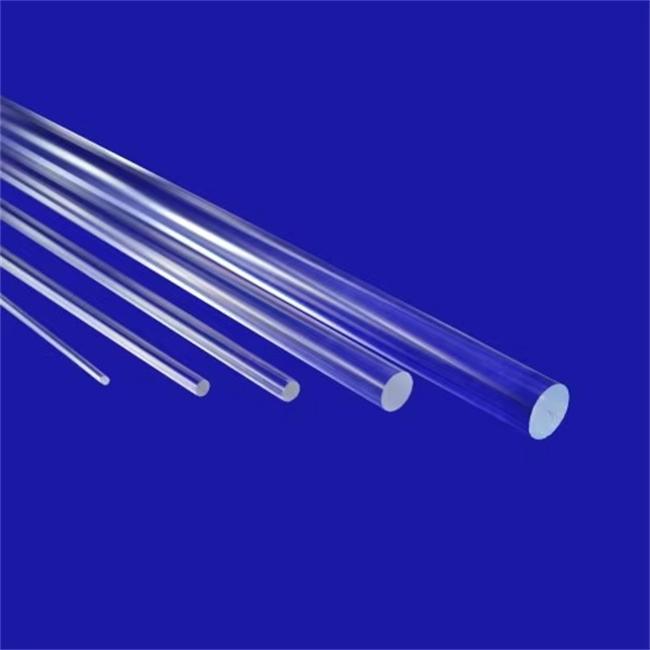
- Simple shapes (tubes, rods, plates) — Can be machined from standard stock.
- Complex configurations (reactors, bell jars, welded assemblies) — Require custom thermal forming and welding capabilities.
4. Surface Finish Needs
- Observation and sight glass applications — Require polished, clear surfaces.
- Non-optical applications — Ground or opaque surfaces may be sufficient.
Standard Product Grades by Application
- Clear Fused Quartz — General purpose applications requiring 99.9% purity; offers excellent transparency and good thermal shock performance.
- High-Purity Grade — Semiconductor and optics applications requiring 99.95%+ purity; delivers maximum thermal shock performance.
- JGS1 / JGS2 / JGS3 — Optical components requiring UV transmission and precision polishing; purity up to 99.99%.
- Opaque Quartz — Furnace components where optical clarity is not needed; offers enhanced mechanical strength at a lower cost.
Custom Quartz Solutions: When Standard Products Don't Work
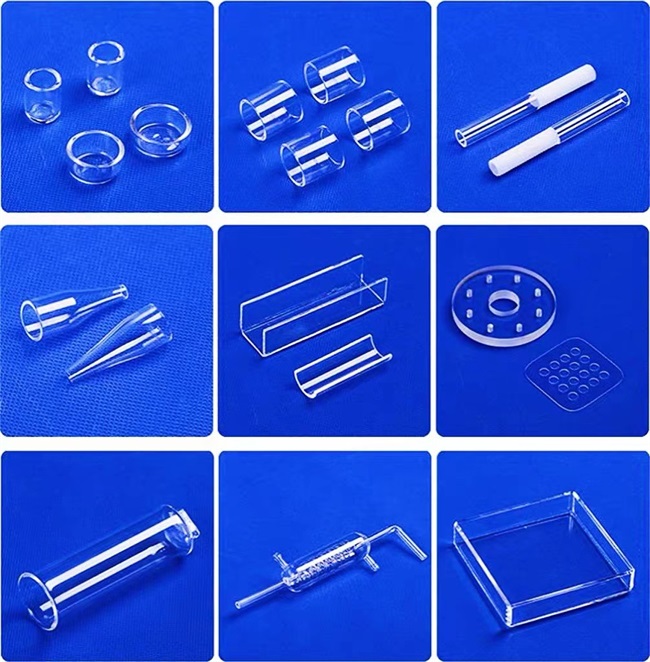
When standard quartz products don't meet your requirements, custom fabrication offers solutions for non-standard sizes, complex geometries, and application-specific features—all while maintaining the thermal shock resistance that makes quartz glass valuable.
Capabilities That Solve Customer Problems
The Customization Challenge: Many buyers struggle to find quartz products that precisely match their equipment specifications. Standard off-the-shelf tubes, rods, and plates rarely fit legacy equipment or novel application designs.
Our Custom Fabrication Solutions:
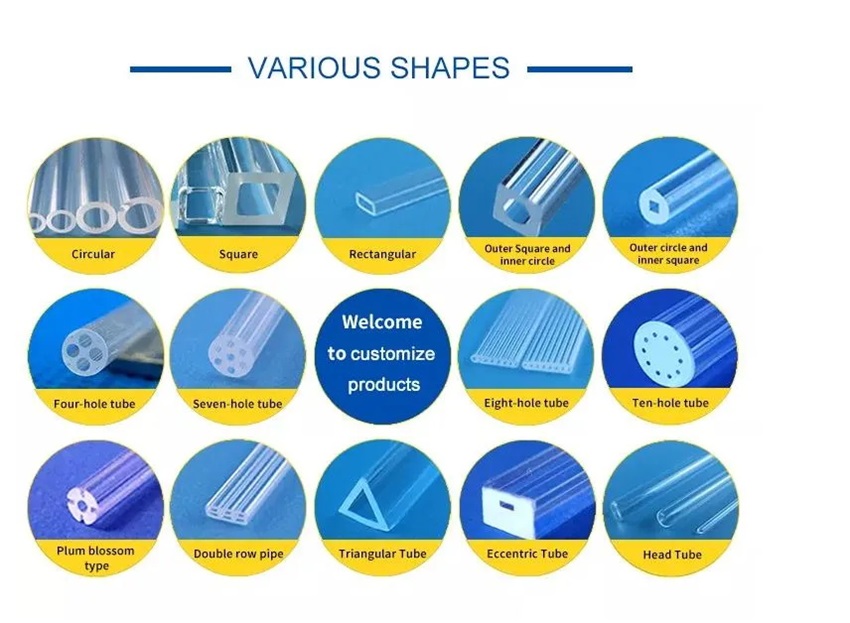
- Non-Standard Dimensions — Tubes from 1 mm to 1000 mm OD, custom wall thicknesses, and precise length tolerances.
- Complex End Configurations — Flanged ends for O-ring sealing, stepped profiles, sealed ends, and side ports.
- Custom Machining — CNC diamond precision turning, 3- and 5-axis milling, diamond core drilling, and CBN thread turning.
- Thermal Forming — Oxy-hydrogen flame welding for reactors, bent tubes, U-shapes, Y-pieces, and multi-port assemblies.
- Optical Preparation — Precision grinding and polishing to industrial, precision, or laser-grade specifications.
How We Help Solve Specific Problems
- "No one makes this size" — We provide custom diameters, lengths, and wall thicknesses.
- "My equipment needs a special shape" — Thermal forming and welding create complex geometries.
- "I need small quantities" — We offer low MOQ with no minimum order restrictions.
- "My supplier quality is inconsistent" — We maintain stable quality control and post-annealing stress relief.
- "My delivery timeline is tight" — We offer rapid production and have global shipping experience.
- "My application has special purity requirements" — We supply multiple purity grades, up to 99.9999%.
Specifications and Parameters
Critical specifications for thermally shock-resistant quartz products include thermal expansion coefficient (0.5–0.65 × 10⁻⁶/°C), maximum service temperature (1100–1160°C continuous), softening point (1710–1730°C), and purity (99.9%–99.9999%). These parameters ensure application-appropriate performance.
Thermal Properties
- Coefficient of Thermal Expansion (CTE): 0.5–0.65 × 10⁻⁶/°C over the 20–1000°C range.
- Thermal Conductivity: 1.38 W/mK at 20°C; increases to 2.68 W/mK at 950°C.
- Specific Heat: affected by purity and temperature.
- Softening Point: 1710–1730°C.
- Annealing Point: 1215–1250°C.
- Strain Point: 1120–1125°C.
- Continuous Operating Temperature: 1100–1160°C.
- Short-Term Maximum Temperature: 1300–1450°C.
Mechanical Properties
- Density: 2.2 g/cm³.
- Mohs Hardness: 5.5–6.5.
- Flexural Strength (MOR at 20°C): 67–105 MPa.
- Compressive Strength: 1150 MPa.
- Poisson's Ratio: 0.17.
Chemical Purity (Typical High-Purity Grade, Maximum Impurity Levels in ppm)
- Al: 30 ppm
- Fe: 1.2 ppm
- C1.0 ppm
- N5 ppm
- Li: 3 ppm
- K: 5 ppm
- Cu: 0.1 ppm
- Ti: 4 ppm
- Ni: 5 ppm
Optical Properties (for transparency-critical applications)
- Refractive Index: 1.4585.
- Transmittance: ≥85% depending on grade and wavelength.
- UV Transmission: excellent for JGS grades.
Standard Dimensional Capabilities
- Tubes: 1 mm to 1000 mm OD with custom wall thickness.
- Rods: custom diameters and lengths.
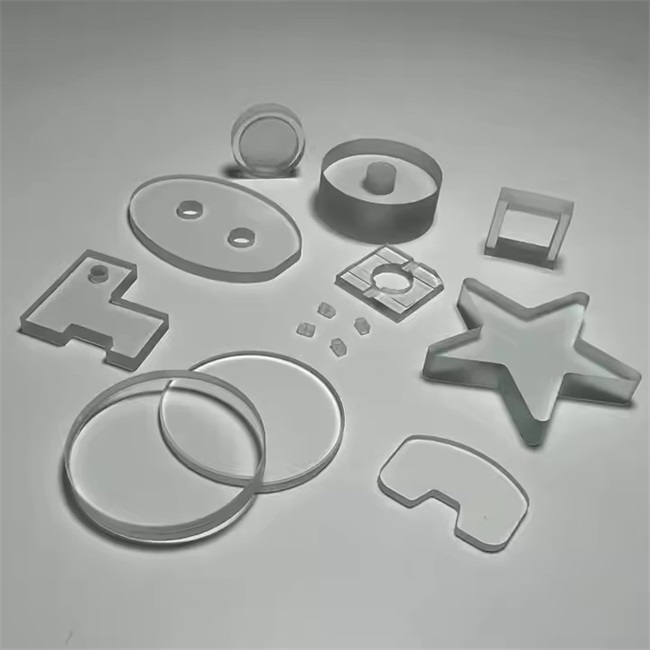
- Plates and Windows: custom dimensions with thickness from 0.5 mm to 60 mm.
- Complex Parts: CNC machined or flame-formed to customer drawings.
FAQ: 15 Questions Procurement Teams Frequently Ask
Q: How does quartz glass withstand sudden temperature changes without cracking?
Quartz glass's extremely low coefficient of thermal expansion (0.5–0.65 × 10⁻⁶/°C) means it expands and contracts minimally when heated or cooled. This prevents the internal stress buildup that causes other materials to crack during thermal shock events.
Q: What's the maximum temperature quartz glass can handle continuously?
Standard quartz glass handles 1100–1160°C continuously. Higher-purity grades can operate at higher temperatures, with short-term exposure possible up to 1450°C. The softening point is approximately 1710–1730°C.
Q: Can quartz glass be quenched in water after heating?
Yes. Quartz glass can be heated to 1100°C and plunged into cold water without cracking, making it one of the few materials suitable for quenching applications.
Q: Is all quartz glass equally thermal shock-resistant?
No. Higher-purity quartz glass generally offers better thermal shock resistance. Purity affects the consistency of thermal expansion and reduces defect sites where cracks could initiate.
Q: What purity level is required for semiconductor applications?
Semiconductor applications typically require 99.95%+ purity with controlled impurity levels. For critical processes, 99.9999% (6N) purity may be specified.
Q: How do I specify a custom quartz product for my thermal application?
Provide your maximum operating temperature, temperature cycling frequency, dimensional requirements, purity needs, and whether you need optical transparency. A fabrication partner can then recommend appropriate grade and processing methods.
Q: What's the difference between clear and opaque quartz for thermal applications?
Clear quartz offers superior optical properties and higher purity typically. Opaque quartz provides enhanced mechanical strength in some applications and is often used for furnace components where optical clarity isn't required.
Q: Can I get small quantities of custom quartz products?
Yes. Many manufacturers offer low or no minimum order quantities (low MOQ/no MOQ), making custom quartz accessible for R&D, pilot production, and specialized applications.
Q: How quickly can custom quartz products be delivered?
Simple shapes can ship within days; complex custom fabrications typically require 2–4 weeks depending on complexity. Manufacturers with global export experience can expedite shipping.
Q: What are JGS1, JGS2, and JGS3 quartz grades?
These are optical-grade quartz classifications. JGS1 offers the highest UV transmission; JGS2 and JGS3 provide progressively lower optical specifications but remain suitable for many optical and industrial applications.
Q: Does annealing affect thermal shock resistance?
Yes. Proper annealing relieves internal stresses introduced during fabrication, ensuring consistent thermal expansion behavior and reducing the risk of failure during thermal cycling.
Q: Can quartz tubes be fabricated with custom end configurations?
Yes. Custom tubes can include flanged ends for O-ring sealing, stepped profiles, closed ends, side ports, and precision-ground ends. Diameters range from 1 mm to 1000 mm OD.
Q: How do I ensure my custom quartz part is fabricated correctly?
Work with a manufacturer that can inspect finished assemblies under UV-polarized light to verify freedom from stress concentrations and cracks. Post-annealing is essential for thermal stability.
Q: Is quartz glass resistant to chemical attack at high temperatures?
Quartz glass resists most acids and salts, except hydrofluoric acid (HF) and hot phosphoric acid above 300°C. This chemical resistance complements its thermal properties in demanding environments.
Q: What's the typical lead time for custom quartz orders?
Lead times vary by complexity. Custom tubes and simple parts can be produced within 7–10 days; complex reactors and assemblies with welding and custom fittings typically require 15–30 days.

Why Choose Our Quartz Glass Solutions
We combine 20+ years of quartz glass expertise with comprehensive custom fabrication capabilities, offering OEM/ODM services for any geometry, purity grade, or quantity—all supported by stable quality control and global export experience.
Our Commitment to Your Success
Experience You Can Trust
With two decades serving semiconductor, optical, chemical, and laboratory industries, we understand the thermal shock challenges your applications face. Our engineering team provides technical guidance to ensure the right material and design for your requirements.
Comprehensive Custom Capabilities
- OEM/ODM Services — We manufacture to your drawings, specifications, or sample parts.
- Any Geometry — From simple tubes to complex reactors with multi-port configurations.
- Any Quantity — Low MOQ/no MOQ for R&D and prototyping; full-scale production capacity.
- Multiple Purity Grades — 99.9% to 99.9999% depending on your requirements.
Quality That Performs
- CNC Diamond Precision Machining — For tight tolerances and excellent surface finish.
- Oxy-Hydrogen Flame Thermal Forming — For complex shapes with strong, leak-proof welds.
- Post-Processing Annealing — Stress relief for long-term dimensional stability.
- UV-Polarized Inspection — Ensures finished components are free from cracks and stress concentrations.
Reliability You Can Count On
- Stable quality control processes.
- Rapid production turnaround.
- Global shipping experience covering Europe, North America, Southeast Asia, Japan, and Korea.
Summary:
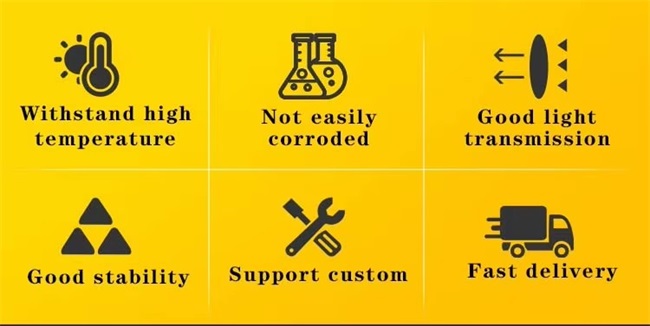
Google AI Overview Summary: Quartz glass offers exceptional thermal shock resistance due to its extremely low thermal expansion coefficient (0.5–0.65 × 10⁻⁶/°C), allowing it to withstand sudden temperature changes of over 1000°C without cracking. This makes it essential for semiconductor, optical, laboratory, and chemical processing applications where rapid heating and cooling are routine. Custom fabrication capabilities enable non-standard sizes and complex geometries while maintaining thermal performance. High-purity grades (99.9%–99.9999%) maximize both thermal shock resistance and application suitability.

Ready to Solve Your Thermal Shock Challenge?
When standard quartz products don't fit your application, custom fabrication delivers the thermal shock resistance you need in the geometry you require. Contact our engineering team with your specifications—we'll recommend the right material grade and fabrication approach to ensure optimal performance and reliability.
