
T: +86-518-85528012
E: nick@luverrequartz.com
E: nick@luverrequartz.com
1st floor Runlian industrial center No. 116 QuFeng Rd., Haizhou Economic and technological development zone Lianyungang City, Jiangsu Province, China 222062
Views: 0 Author: Site Editor Publish Time: 2026-10-29 Origin: Site


What is a quartz sleeve, and why does selection matter?
Quartz sleeve is a high-purity fused silica tube used to protect UV lamps, isolate process environments, or serve as a structural support component in high-temperature equipment. Selection matters because an incorrectly specified sleeve—wrong OD, insufficient wall thickness, or inappropriate material grade—can cause fitment failures, UV transmission loss, or premature devitrification in service.
This guide is written for procurement managers, engineers, and OEM buyers who need to source quartz sleeves that actually fit their equipment and survive their operating conditions. Rather than catalog specifications, it addresses the real problems buyers face: non-standard dimensions, tight tolerances, small-batch customization, and inconsistent supplier quality.

What Quartz Sleeves Do
What is the primary function of a quartz sleeve?
The primary function of a quartz sleeve is to provide a chemically inert, thermally stable, and optically transparent barrier between a functional element (such as a UV lamp or process heater) and its surrounding environment. In UV water treatment, the sleeve transmits germicidal wavelengths (typically 254 nm) while protecting the lamp from water contact. In semiconductor and furnace applications, quartz support sleeves provide structural alignment and gas flow channels without introducing metallic contamination.
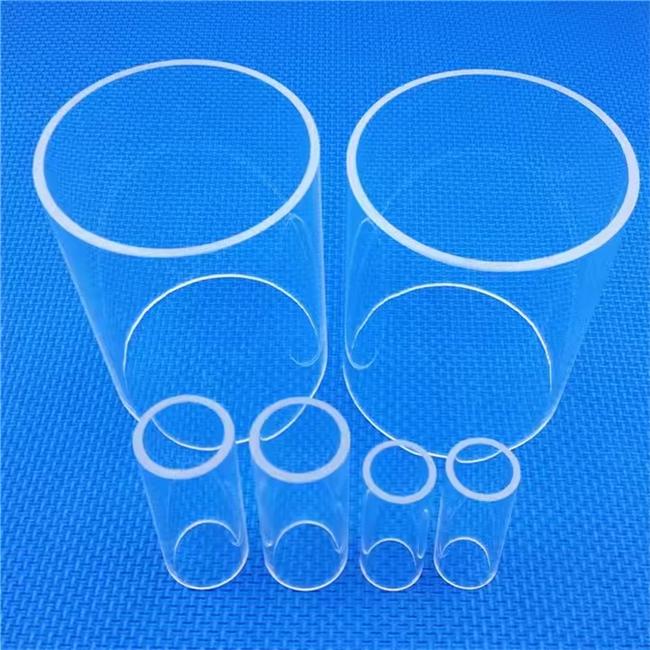
Our quartz sleeves are manufactured from high-purity fused silica with SiO₂ content ≥99.99%. We produce sleeves in three configurations: open at both ends, closed at one end (domed), and flared at one end, matching the form factors used across UV disinfection systems, lab furnaces, and process equipment.

Size Selection: Getting the Fit Right
How do I determine the correct quartz sleeve dimensions?
To determine the correct dimensions, you need four measurements from your existing sleeve or equipment interface: total length, outside diameter (OD), inside diameter (ID), and end configuration. The OD must clear your equipment bore with a small air gap to avoid thermal stress; the ID must accommodate the lamp or insert with sufficient clearance for thermal expansion.
For UV lamp sleeves, common OD ranges run from 19 mm to 48 mm, with wall thicknesses between 1.0 mm and 2.0 mm. A thinner wall improves UV transmission and reduces thermal mass; a thicker wall provides greater mechanical strength and better vacuum resistance. For furnace and semiconductor support sleeves, dimensions are almost always application-specific and should be matched to the process tube ID or wafer carrier geometry.
The most common sourcing problem we solve: customers have an existing sleeve with worn or missing markings, no reliable drawing, and a production line that cannot wait for a full re-engineering cycle. We accept physical samples and reverse-engineer the critical dimensions, or work directly from hand-sketched drawings with key measurements. This is routine for us, not an exception.

Temperature Resistance: What Quartz Can and Cannot Handle
What is the maximum service temperature for a quartz sleeve?
The practical maximum service temperature for continuous use of fused quartz sleeves is 1100°C to 1200°C. Above approximately 1200°C, quartz begins to devitrify—transforming from amorphous silica into cristobalite—which makes the material opaque, brittle, and prone to cracking. The softening point of quartz glass is significantly higher (around 1700°C), but structural deformation and devitrification risk make sustained operation above 1200°C impractical for most sleeve applications.
Temperature resistance is not just about the absolute number. Thermal shock—rapid heating or cooling—is the more common failure mode in service. A thick-walled sleeve that looks robust on paper may crack under a fast ramp because the temperature gradient across the wall creates differential expansion. For applications requiring frequent thermal cycling, we recommend specifying a thinner wall within the mechanical constraints of the design, and we can advise on safe ramp rates based on the wall thickness and diameter.
For processes that genuinely require sustained operation above 1200°C, quartz is the wrong material, and we will tell you so. Alumina or silicon carbide tubes are appropriate alternatives in that regime.
Material Grades: Matching Purity and Optical Performance to Your Application
Which quartz grade should I choose for my sleeve?
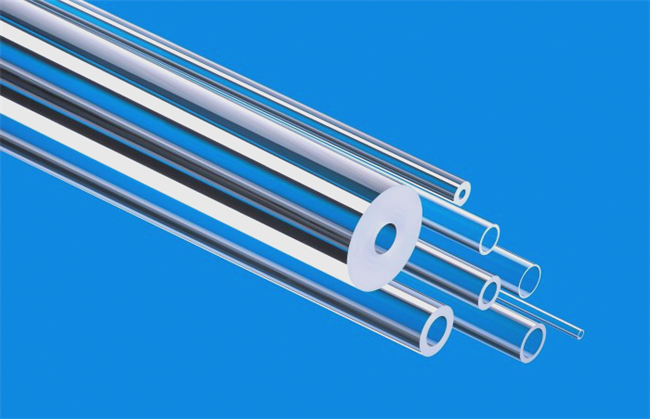
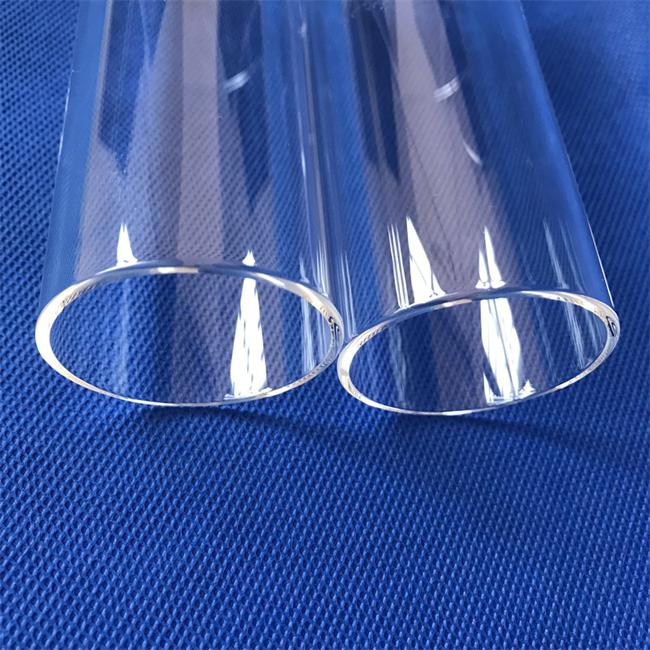
The correct grade depends on whether your priority is optical transmission, contamination control, or cost. For UV disinfection sleeves operating at 254 nm, standard fused silica with high UV transmittance is sufficient and cost-effective. For semiconductor and high-purity laboratory applications, synthetic fused silica grades (such as JGS1) offer lower metallic impurity levels and are preferred where trace contamination affects yield or analytical accuracy.
The key distinction buyers should understand is between natural fused quartz and synthetic fused silica. Natural quartz is melted from high-purity crystal and offers excellent thermal and mechanical properties at lower cost. Synthetic silica is produced from silicon-containing precursors and achieves lower metal content but at a higher price point. For UV sleeves, the optical transmission at 254 nm is the governing specification; for semiconductor support sleeves, the metal impurity profile matters more than transmission.
If you are unsure which grade your application requires, send us the operating wavelength, the contamination sensitivity of your process, and your budget range. We will recommend a grade rather than defaulting to the most expensive option.
Applications: Where Quartz Sleeves Are Used
What industries rely on quartz sleeves?
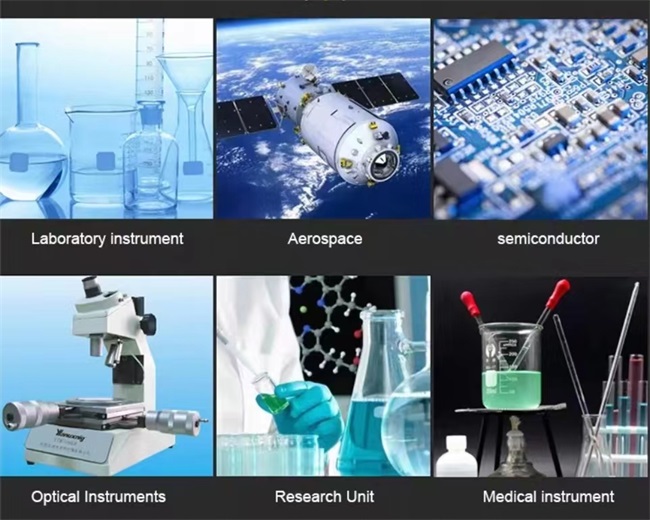
Quartz sleeves appear in four primary application categories, each with distinct selection priorities:
UV Disinfection and Water Treatment. The sleeve protects the UV lamp from water while transmitting germicidal radiation. Selection priority: precise OD/ID for lamp fitment, high transmission at 254 nm, and ozone-free grade if the lamp emits below 240 nm.
Semiconductor Processing. Quartz support sleeves in diffusion furnaces provide gas flow channels and structural alignment without metallic contamination. Selection priority: high purity, precise machining of sealing channels, and dimensional stability at process temperature.
Laboratory and Analytical Equipment. Quartz sleeves serve as reaction vessels, optical cells, and thermal isolation barriers. Selection priority: chemical inertness, optical clarity, and compatibility with existing labware dimensions.
Industrial Heating and Furnace Equipment. Sleeves act as protective barriers or structural spacers around heating elements and process tubes. Selection priority: thermal shock resistance, wall thickness for mechanical load, and cost-effective customization for non-standard sizes.
Custom Specifications: What We Can Make
What customization options are available for quartz sleeves?
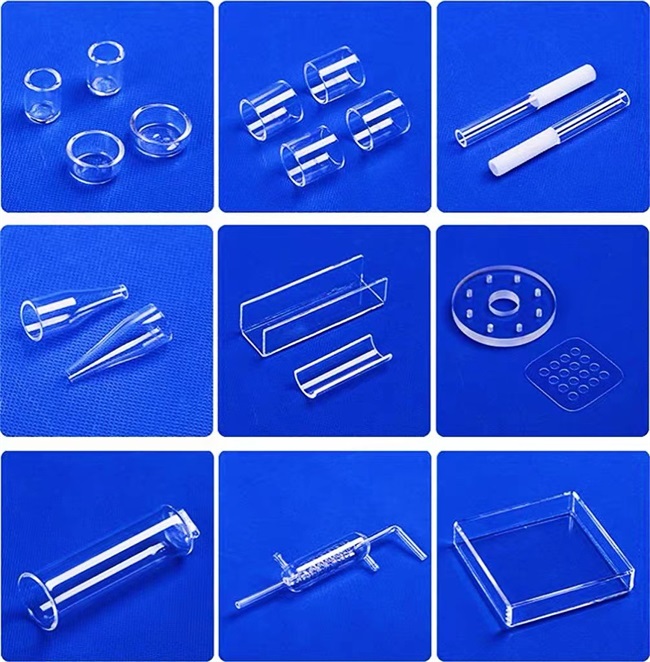
We manufacture quartz sleeves to your drawing, your sample, or your stated dimensions. Rather than presenting these as fixed product lines, treat the following capabilities as the boundaries within which we routinely work—most orders fall somewhere between standard and fully bespoke.
Outside diameter ranges from 5 mm to 200 mm, with sizes outside this range quoted on request. Wall thickness typically runs from 0.8 mm to 5.0 mm. Length can reach up to 2000 mm depending on the diameter and wall ratio.
End configurations include open at both ends, closed at one end (domed), flared, threaded, or with custom machining. Material grades cover natural fused quartz in standard and high-purity versions, as well as synthetic fused silica. Surface finish options are as-fired, ground, or polished, with optical polishing available for window applications. Additional features include slots, holes, step transitions, flange integration, and chamfers.
For customers with urgent requirements, we maintain rapid turnaround capability on small batches: typical lead time for custom sleeves is 7–15 working days depending on complexity and quantity. We do not impose a minimum order quantity on most custom runs; a single prototype and a 500-piece production order receive the same engineering attention.
How to Choose a Supplier (and What to Ask)
What should procurement ask a quartz sleeve supplier before ordering?
Ask three questions that separate capable custom manufacturers from catalog resellers:
First: “Can you work from my sample?” A supplier that requires a complete, dimensioned drawing for every order will struggle with legacy equipment and replacement-part scenarios. Sample-based reverse engineering is a core capability, not an add-on.
Second: “What is your dimensional tolerance on custom sleeves?” For UV lamp sleeves, OD tolerance directly affects fitment and transmission uniformity. For semiconductor support sleeves, channel dimensions and flatness matter. Vague answers (“close tolerance”) are a warning sign; specific numbers are a good sign.
Third: “How do you handle a first article?” For critical applications, a first-article inspection with dimensional report and material certification should be available before full production. Suppliers who resist this step are telling you something about their quality system.
We address these questions directly: sample-based production is standard, tolerances are quoted per dimension per drawing, and first-article documentation is provided on request for OEM and semiconductor customers.
FAQ
What is the difference between a quartz sleeve and a quartz tube?
A quartz tube is a general term for hollow quartz cylinders. A quartz sleeve typically refers to a tube used as a protective barrier or support component—particularly around UV lamps or in furnace assemblies. The manufacturing process is similar; the distinction is functional.
Can you make a quartz sleeve from my sample even if I don’t have a drawing?
Yes. Send the sample with critical dimensions marked or described. We measure and confirm before production. This is common for replacement parts and legacy equipment.
What is the maximum temperature for continuous use?
1100°C to 1200°C for sustained operation. Above this range, devitrification and deformation risk increase significantly.
Do you offer low MOQ for custom sleeves?
Yes. Most custom sleeve orders have no strict minimum beyond one piece for prototyping. Small-batch production runs of 10–50 pieces are routine.
How fast can you ship a custom quartz sleeve?
Typical custom lead time is 7–15 working days after drawing or sample approval. Rush options are available for urgent requirements.
What material grade is best for UV disinfection?
Standard fused quartz with high transmission at 254 nm. Specify ozone-free grade if your lamp emits below 240 nm.
Can quartz sleeves be used in vacuum applications?
Yes, but wall thickness and end configuration must be selected for vacuum load. Thicker walls provide better resistance to collapse; domed ends are preferred over flat closed ends.
Do you polish quartz sleeves for optical use?
Yes. Optical polishing is available for sleeve applications requiring transmission uniformity or use as a window component.
What tolerance can you hold on OD and ID?
Tolerances are quoted per dimension based on the drawing and application. Typical achievable tolerances are ±0.1 mm to ±0.3 mm depending on size and wall thickness.
Can you integrate a flange or step into the sleeve?
Yes. We machine flanges, steps, slots, and holes directly into the sleeve body as a single piece, eliminating secondary assembly and potential leak paths.
How do you pack quartz sleeves for export?
Each sleeve is individually wrapped in cleanroom-compatible foam or paper, then packed in rigid foam-lined cases. Custom packaging for OEM line-side delivery is available.
Do you provide material certificates?
Yes. Material composition reports and dimensional inspection reports are available on request.
What is the difference between JGS1 and JGS2 quartz?
JGS1 is synthetic fused silica for deep UV and high-purity applications. JGS2 is natural quartz commonly used for UV and visible transmission where metal content is less critical.
Can you produce sleeves with one end closed?
Yes. Domed closed ends are standard. Flat closed ends are available but not recommended for vacuum or high-temperature pressure differential applications.
How do I confirm my sleeve will fit before ordering?
Send us the mating component dimensions (lamp OD, bore ID, insertion depth) or the existing sleeve. We will confirm the critical fit dimensions before quoting or producing.

Why Choose Us
What does a quartz sleeve buyer actually need from a supplier?
The answer is rarely “the lowest price per piece.” It is a supplier who can take an incomplete specification, a worn sample, or a tight timeline and still deliver a sleeve that fits and performs. That is the problem we are organized to solve.
We solve the non-standard sizing problem. Standard catalogs cover a narrow band of UV lamp diameters. When your equipment falls outside that band—or when the original supplier has discontinued the size—we reverse-engineer from the sample or build to your measured dimensions.
We solve the small-batch problem. Many quartz manufacturers set minimum order quantities that make prototype and replacement-part procurement impractical. We produce one piece or one thousand with the same process control.
We solve the quality consistency problem. Every custom order runs against a documented dimensional plan. First-article inspection and material certification are available, so you are not discovering a tolerance drift three months into a production run.
We solve the lead-time problem. Custom quartz sleeves in 7–15 working days, with expedited options for breakdown and line-down situations. Our export experience covers North America, Europe, and Asia-Pacific, with documentation and packaging suited to international freight.
If your current sleeve is out of spec, out of stock, or out of production, send us the dimensions or the sample. We will tell you what we can do—and if quartz is the wrong material for your temperature range, we will say that too.
Quartz sleeve is a high-purity fused silica tube used to protect UV lamps, isolate process environments, or support high-temperature components. When selecting a quartz sleeve, buyers should confirm four dimensions (length, OD, ID, end configuration), verify the continuous service temperature does not exceed 1100–1200°C, and choose between natural fused quartz and synthetic fused silica based on whether UV transmission or contamination control is the governing requirement. For non-standard sizes, legacy equipment, or small-batch orders, sample-based custom manufacturing with low MOQ and 7–15 day lead times is the practical sourcing route.

Luverre Quartz manufactures and sells a wide range of high quality quartz glass, including quartz tubes, quartz plates, quartz rods, quartz windows, quartz crucibles, quartz boats, quartz flanges, quartz beakers, quartz glass instruments, and more. We can meet all kinds of customized requirements for quartz glass products.
