T: +86-518-85528012
E: nick@luverrequartz.com
1st floor Runlian industrial center No. 116 QuFeng Rd., Haizhou Economic and technological development zone Lianyungang City, Jiangsu Province, China 222062
Views: 0 Author: Site Editor Publish Time: 2026-11-24 Origin: Site


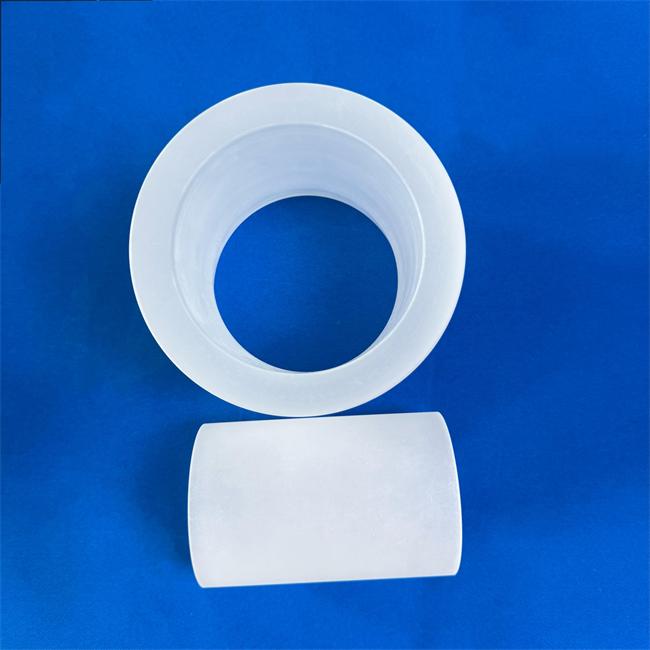
The core difference between transparent quartz tubes and milky (opaque) quartz tubes lies in optical properties and thermal radiation behavior, not in the base material itself. Both are fused silica (SiO₂) and share the same chemical purity, high-temperature resistance, and thermal stability. The decision comes down to one question: does your application need light / UV–IR transmission, or does it need infrared scattering and thermal shielding? Transparent tubes suit observation, light transmission, and UV curing. Milky tubes suit uniform heating, IR radiation shielding, and concealing internal components.
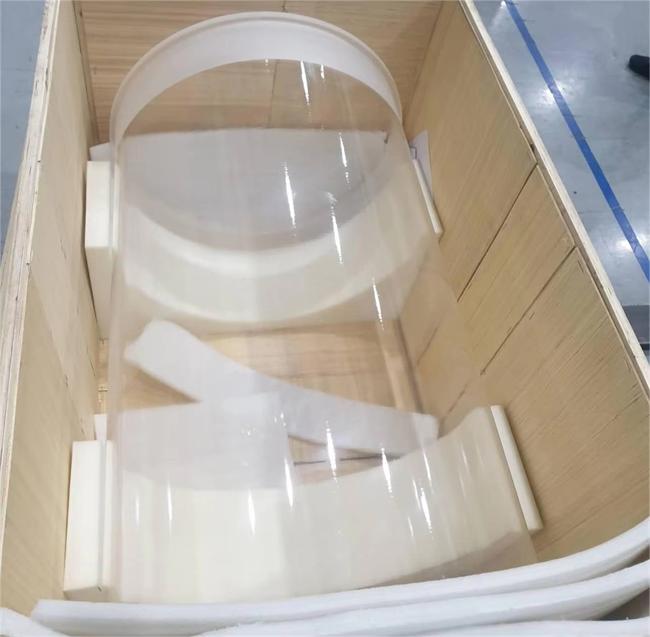
Same Material, Different Microstructure
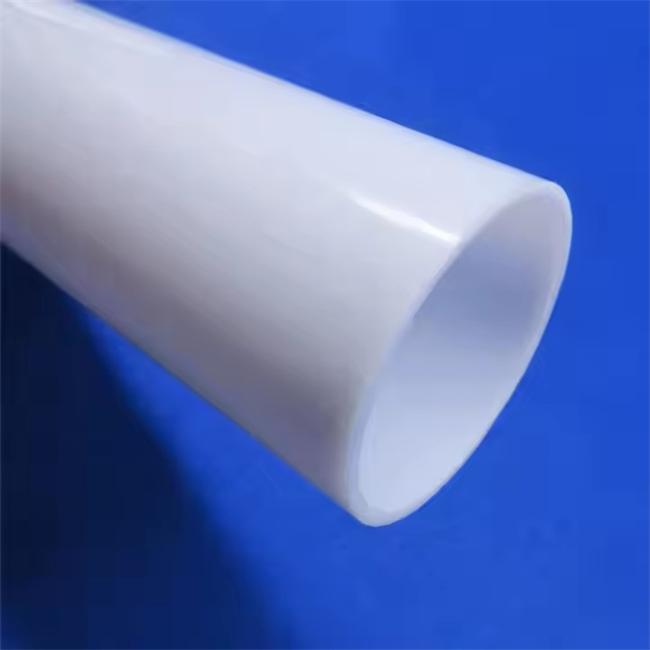
Transparent and milky quartz tubes are made from the same base material: amorphous silicon dioxide. Milky tubes appear white because micron-scale bubbles (typically 5–50 µm in diameter) are intentionally introduced during melting. These bubbles are evenly distributed throughout the glass matrix and strongly scatter visible and infrared radiation, eliminating transparency and producing a milky or translucent appearance.
The introduction of bubbles does not change the material's softening point, thermal expansion coefficient, chemical resistance, or purity. It changes only one function: how light and thermal radiation are transmitted. A transparent tube lets radiation pass straight through; a milky tube scatters it in all directions.

Key Performance Comparison
Optical transmission. Transparent tubes offer high transmission across UV, visible, and IR — typically ≥89% at 250 nm and ≥91% at 400 nm for 1 mm wall thickness. Milky tubes have very low visible transmission, usually below 10% at 500 nm.
Infrared behavior. Transparent tubes transmit IR radiation directly through the wall. Milky tubes scatter it strongly, creating uniform diffuse radiation and reducing direct thermal shock and localized hot spots.
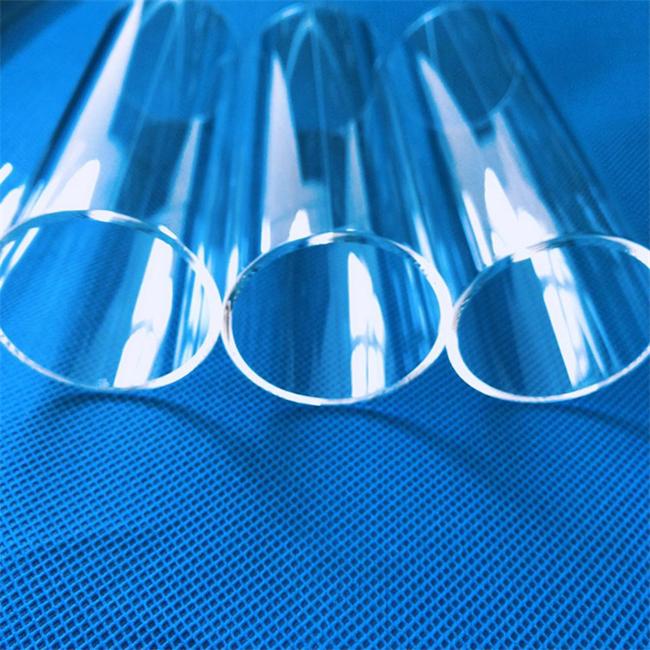
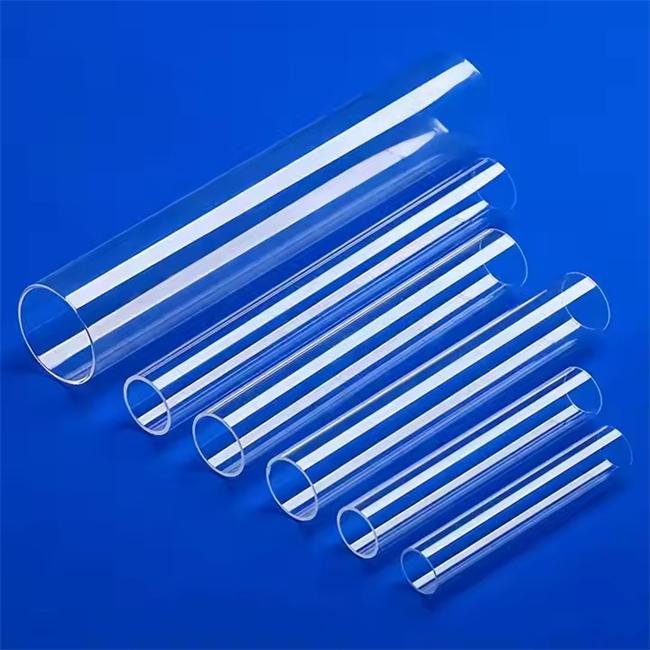
Appearance. Transparent tubes are clear and colorless, allowing clear observation of the interior. Milky tubes are white/translucent and conceal internal components.
Primary functional role. Transparent tubes are for light transmission, observation, UV curing, and optical transmission. Milky tubes are for infrared heating, thermal shielding, and temperature homogenization.
Thermal stability and chemical resistance. These are identical for both types. Both have a softening point around 1730°C and long-term service temperature around 1100°C. Both resist most acids except hydrofluoric acid and hot phosphoric acid.
How to Choose Based on Application
When to choose transparent quartz tubes
Transparent tubes are the default choice for optical and observation applications.
Semiconductor and wet-process applications. Wherever the internal reaction state, liquid level, or wafer position must be observed, a transparent tube is the only option. Transparent quartz tubes are widely used in semiconductor, pharmaceutical, chemical, and laboratory R&D settings.
UV and optical systems. Applications requiring UV transmission — photochemical synthesis, UV curing, spectral analysis — must use transparent tubes. Transparent quartz tubes still achieve ≥83% transmission at 185 nm (1 mm wall thickness).
Heating processes requiring visual inspection. If operators must observe sample condition through the tube wall (color change, melting degree, deposition), a milky tube would completely block the view.
When to choose milky quartz tubes
The core value of milky tubes is thermal management, not optics.
Outer sleeves for infrared heating elements. Milky quartz tubes are the standard sleeve material for halogen heating lamps, infrared heaters, disinfection cabinets, microwave ovens, and electric ovens. Their micro-bubble structure scatters the directional IR radiation from the tungsten filament into uniform diffuse heat, preventing localized overheating while withstanding high temperature and thermal shock.
Industrial furnace liners and muffle tubes. Used as liners in resistance or induction furnaces, milky quartz tubes shield workpieces from direct radiation from heating elements, producing a more uniform temperature distribution. For heat treatment, annealing, and sintering, this uniformity matters more than maximum heat flux.
Applications requiring concealment of internal components. When equipment appearance must be clean, or internal heating wires/structure should not be exposed, the opacity of milky tubes provides visual concealment.
Heat-sensitive materials. Milky tubes scatter and block both UV and IR, reducing the potential impact of UV radiation on certain materials such as some polymers or coatings.
Key Parameters to Confirm When Purchasing
Regardless of type, the following parameters should be clearly specified with your supplier.
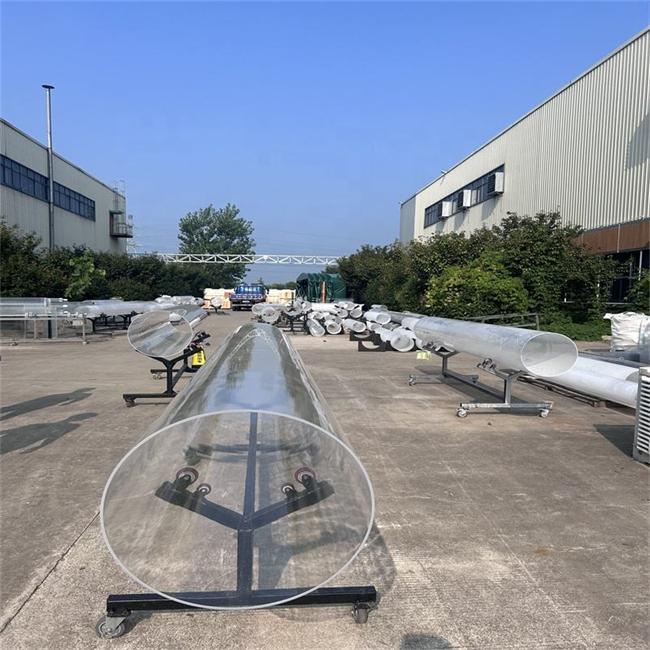
Dimensions and tolerances. Outer diameter, inner diameter, wall thickness, and length. Transparent tube tolerances are usually controlled more tightly (affecting optical path and sealing fit). For milky tubes, the uniformity of bubble distribution affects batch-to-batch consistency of scattering performance and should also be included in specification confirmation.
Purity grade. Transparent tubes in semiconductor or optical applications typically require high purity (e.g., SiO₂ ≥99.9%). For milky tubes used in heating elements, purity requirements can be relaxed somewhat, but alkali metal content still affects devitrification tendency at high temperature.
Bubble specifications (milky tubes only). Bubble size distribution and density directly determine scattering efficiency and opacity. Too few or too-large bubbles can cause uneven light blocking; a uniform, fine bubble distribution is the hallmark of stable quality.
End-face processing. Whether fire polishing, square cutting, chamfering, or flange connection is required. Both transparent and milky tubes can be hot-worked and welded, but fire polishing a milky tube closes surface micro-pores and may alter local scattering characteristics.
Common Misconceptions
Misconception 1: Milky tubes are a "lower-grade" material. Material costs are similar. Manufacturing milky tubes requires precise control of bubble introduction, and the process is no less demanding than drawing transparent tubes. The choice depends on functional requirements, not quality grade.
Misconception 2: Milky tubes are completely opaque. Milky tubes scatter rather than completely block. They allow some radiation to pass in diffuse form, eliminating only directional transmission. Under a strong light source, a milky tube still emits a soft glow.
Misconception 3: Transparent tubes can replace milky tubes in heaters. Technically feasible, but a transparent tube lets IR radiation pass straight through, causing overheating in the direction facing the heating element and insufficient heating on the opposite side — significantly degrading temperature uniformity.
Customization and Supply
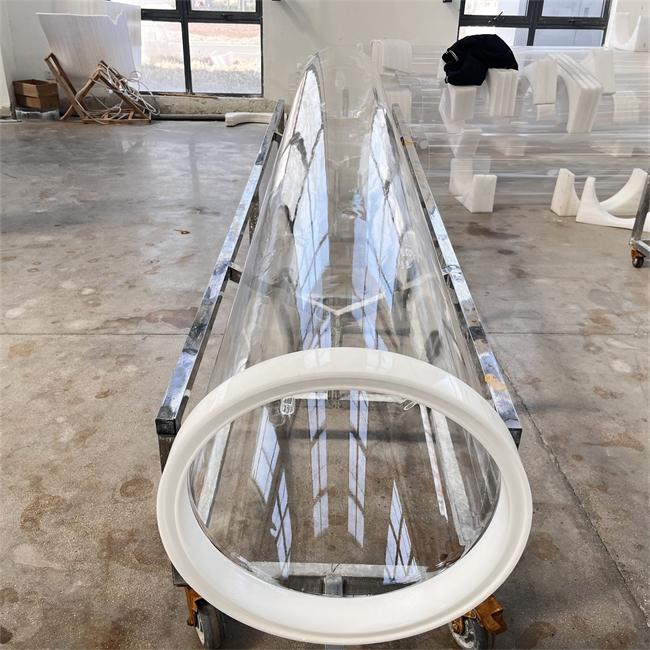
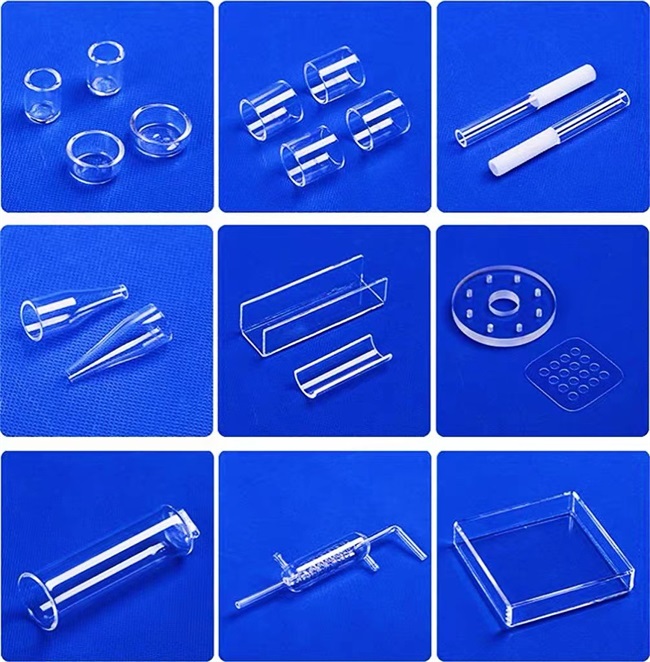
We supply both transparent and milky quartz tubes, with customization to drawings or samples. We can help determine the right type for your equipment conditions and confirm dimensional tolerances, bubble specifications, and end-face processing requirements. Small-batch trial runs and volume production are available, with worldwide export.
FAQ
Can transparent and milky quartz tubes be welded together?
Yes. Milky quartz tubes can be welded directly to transparent quartz tubes without significant shrinkage or stress concentration at the joint. This is commonly used to make composite parts with a transparent observation section at one end and a milky heating section at the other.
Does the IR-shielding effect of milky tubes mean lower heating efficiency?
No. Milky tubes convert directional radiation into diffuse radiation; total energy is not lost, only its spatial distribution changes. For workpieces requiring uniform heating, actual thermal efficiency may be higher because localized overheating and cold zones are reduced.
Is the maximum service temperature the same for both types?
With the same base material, long-term service temperature is approximately 1100°C for both, with short-term capability higher. Actual service life depends on the specific atmosphere, heating/cooling rate, and support structure, and should be confirmed for your operating conditions.
How can I judge the quality of a milky tube?
Examine the uniformity of bubble distribution. Inspect the wall under backlighting: a high-quality milky tube should appear uniformly milky white, with no obvious clusters of large bubbles or transparent streaks. The more uniform and fine the bubble size and distribution, the more consistent the scattering effect.
Not sure which type fits your application? Tell us your operating temperature, whether you need light transmission/observation, and your heating method (radiation, convection, or conduction). We can give you a specific recommendation and a quote.

Luverre Quartz manufactures and sells a wide range of high quality quartz glass, including quartz tubes, quartz plates, quartz rods, quartz windows, quartz crucibles, quartz boats, quartz flanges, quartz beakers, quartz glass instruments, and more. We can meet all kinds of customized requirements for quartz glass products.
