
T: +86-518-85528012
E: nick@luverrequartz.com
E: nick@luverrequartz.com
1st floor Runlian industrial center No. 116 QuFeng Rd., Haizhou Economic and technological development zone Lianyungang City, Jiangsu Province, China 222062
Views: 0 Author: Site Editor Publish Time: 2025-11-11 Origin: Site


High purity quartz glass has become an irreplaceable key material in fields such as semiconductors, optical communications, aerospace, and high-end laboratory equipment due to its excellent optical, thermal, chemical, and electrical properties. However, transforming basic quartz materials into precision instruments that meet extreme working conditions requires a series of complex deep processing techniques.

Core deep processing technology method
The deep processing of quartz instruments is a multi process, high-tech process, mainly divided into three categories: hot processing, cold processing, and special processing.
1. Hot processing technology
Hot processing is a technique that utilizes the softening and melting properties of quartz glass at high temperatures (usually above 1600 ℃) for shaping and bonding.
Method:
Lamp welding: Technicians use hydrogen oxygen flame or plasma flame spray lamps to locally heat quartz tubes and rods, and use techniques such as blowing, pulling, bending, and joining to create complex shapes such as tees, crosses, serpentine condenser tubes, diffusion tubes, etc.
High temperature sealing: Directly melt and bond two or more quartz components at high temperatures to form a permanent, seamless vacuum tight connection. Commonly used for manufacturing observation windows, light source housings, and semiconductor process chamber components.
The core problem to be solved is to achieve one-time molding and adhesive free connection of complex structures, avoiding the risks of contamination, aging, and vacuum leakage caused by the use of glue or mechanical seals.
Typical product applications:
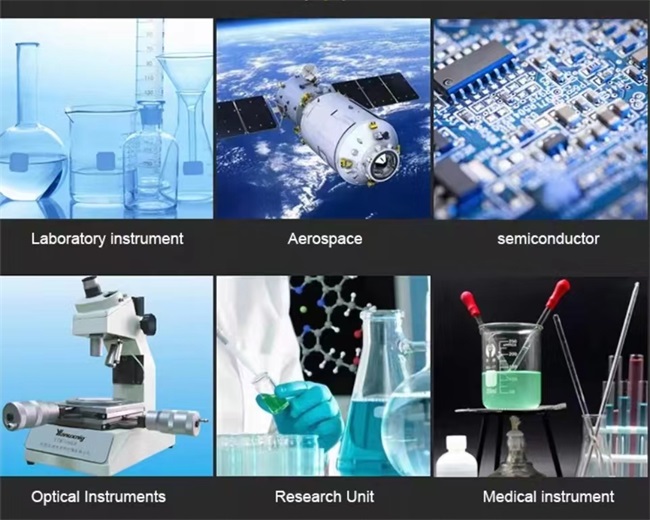
Semiconductor industry: quartz boat, quartz bell jar, gas delivery pipeline in CVD (chemical vapor deposition) and diffusion processes.
Laboratory instruments: high-precision fractionation column, condenser, reactor liner.
Light source industry: quartz shells for xenon lamps, mercury lamps, and ultraviolet lamps.

2. Cold processing technology
Cold processing is mainly the mechanical processing of quartz glass at room temperature to achieve the desired size, shape, and surface finish.
Method:
Precision cutting: using high-precision diamond cutting blades, laser cutting or waterjet cutting to achieve high-precision and low edge breakage cutting.
CNC engraving and drilling: Using computer-controlled diamond grinding heads, complex patterns can be engraved or high-precision drilling can be performed on quartz plates, with aperture sizes as small as micrometers.
Grinding and polishing: Use diamond abrasives of different particle sizes to grind step by step, and finally obtain optical grade (such as λ/10) ultra smooth surfaces through techniques such as chemical mechanical polishing.
The core problem to be solved is to achieve high dimensional accuracy, complex geometric shapes, and extremely low surface roughness of quartz instruments, meeting the extremely high requirements for flatness and smoothness in applications such as optical imaging and wafer loading.
Typical product applications:
Lithography machine: ultra-high flatness quartz lenses and prisms in the lithography machine lens system.
Wafer manufacturing: Quartz photomask plates used to carry silicon wafers.
Analytical instruments: quartz cuvette for UV/visible spectrophotometer, sampling cone and extraction cone for ICP-MS (inductively coupled plasma mass spectrometry).

3. Special processing technology
Advanced processing technology developed to meet specific high-performance requirements.
Method:
Hot pressing molding: quartz glass powder is placed in a mold and sintered at high temperature and high pressure in one go, used to manufacture components with complex shapes that are difficult to achieve through cold and hot processing.
Plasma/flame spraying: Quartz powder is melted by a high-temperature plasma flame and sprayed onto the surface of the substrate to form a dense quartz coating for corrosion resistance or insulation protection.
Chemical etching: Selective etching of quartz surfaces using etching solutions such as hydrofluoric acid, used to create microchannels, microstructures, or reduce surface defects.
The core problem to be solved is to break through the limitations of traditional processing methods and achieve special structures, composite functions, or extreme surface performance requirements.

Typical product applications:
Aerospace: Composite quartz components for rocket fairings and high-temperature observation windows.
Microfluidic chip: a miniature quartz channel chip used for biochemical analysis.
Corrosion resistant equipment: Coating on the inner wall of large quartz reaction vessels in the chemical industry.
The core advantages and value brought by deep processing technology
Through the above-mentioned deep processing technology, quartz materials have transformed from "high-quality raw materials" to "high-performance instruments", and their value has doubled:
1. Performance customization: The most suitable quartz instrument can be designed and processed according to specific applications such as UV transparency, high temperature resistance, and high insulation, maximizing the potential of the material.
2. High reliability and long lifespan: The seamless structure and ultra-high purity avoid pollution sources and weak points, allowing the instrument to have extremely long service life and stability in harsh environments such as high temperature, strong corrosion, and thermal cycling.
3. Improve system efficiency: For example, in semiconductor equipment, quartz chambers with precision polished inner walls can reduce particle contamination and directly improve chip yield; In optical communication, low loss quartz connectors ensure efficient signal transmission.

The deep processing technology of quartz instruments is an indispensable precision technology in modern high-end manufacturing industry. From traditional lighting techniques to advanced CNC and laser processing, each method is a solution tailored to specific application scenarios and performance requirements. Understanding these process methods, their corresponding product applications, and the core problems they solve is crucial for technology selection and innovation in fields such as semiconductors, photonics, aerospace, and scientific research.
Luverre Quartz manufactures and sells a wide range of high quality quartz glass, including quartz tubes, quartz plates, quartz rods, quartz windows, quartz crucibles, quartz boats, quartz flanges, quartz beakers, quartz glass instruments, and more. We can meet all kinds of customized requirements for quartz glass products.
