
T: +86-518-85528012
E: nick@luverrequartz.com
E: nick@luverrequartz.com
1st floor Runlian industrial center No. 116 QuFeng Rd., Haizhou Economic and technological development zone Lianyungang City, Jiangsu Province, China 222062
Views: 0 Author: Site Editor Publish Time: 2026-11-12 Origin: Site


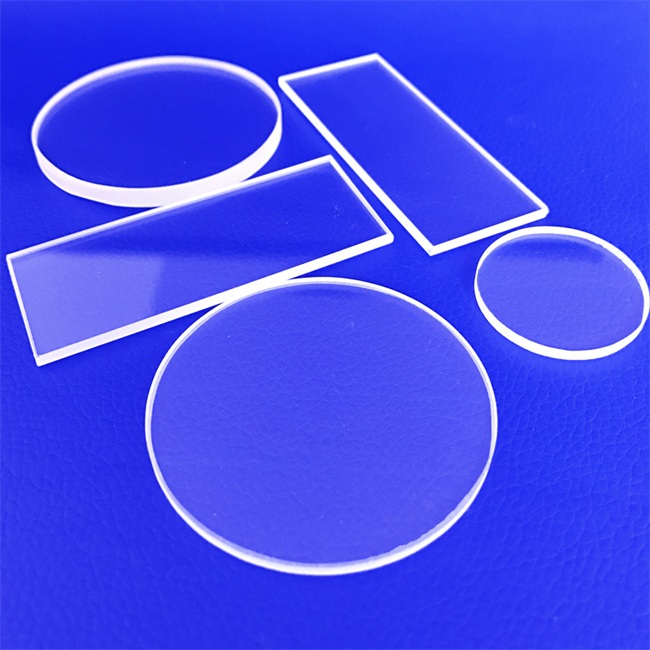
The purity grade of quartz glass you should choose depends almost entirely on how sensitive your process is to trace contamination. For general industrial furnace tubes and chemical apparatus, fused quartz with 99.9%–99.99% SiO₂ and total metallic impurities below roughly 20–50 ppm is usually sufficient. For semiconductor diffusion, oxidation, and wafer handling components, you need 99.99%+ SiO₂ with impurity levels controlled in the low ppm range, ideally with verified low sodium and potassium. For deep-UV optics, photomask substrates, and synthetic quartz applications, you should specify synthetic fused silica with metallic impurities in the ppb range and tightly controlled OH content. Choosing a higher purity than your process requires adds cost without improving yield; choosing lower purity can introduce mobile ions, bubbles, or particulate contamination that cause batch failures.
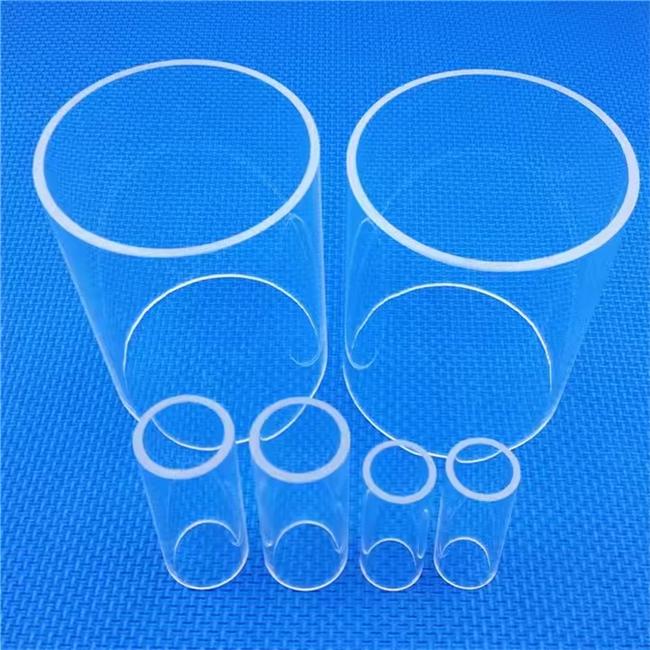
What Does “Purity” Actually Mean in Quartz Glass?
In quartz glass, purity primarily refers to the total concentration of metallic impurity elements—especially Na, K, Li, Ca, Fe, Al, and Cu—along with hydroxyl (OH) content and bubble/defect density. It does not simply mean “how clear the glass looks.”
Quartz glass is composed almost entirely of SiO₂, but the residual trace elements determine its behavior in high-temperature and contamination-sensitive processes. A visually transparent tube can still release enough sodium at 1200°C to ruin a semiconductor diffusion run.
At the industrial end, fused quartz typically runs 99.9%–99.95% SiO₂ with total metals in the 20–100 ppm range and OH content around 100–300 ppm. It is cost-effective and perfectly adequate for lighting envelopes, general furnace sight glasses, and non-critical chemical ware, but it is not intended for semiconductor front-end processes.
At the high-purity end, fused quartz reaches 99.99%+ SiO₂ with total metals below 10–20 ppm and sodium and potassium individually below 1 ppm. OH content generally stays in the 100–200 ppm range. This grade covers many semiconductor support parts, laboratory digestion vessels, and high-temperature fixtures where contamination control matters but ppb-level performance is not required.
At the top end, synthetic fused silica reaches 99.999%+ SiO₂ with metallic impurities measured in the ppb range and OH content controlled according to type—high-OH grades for deep-UV transmission, low-OH grades for IR and applications where hydroxyl absorption is undesirable. This is the grade specified for lithography optics, photomask substrates, and excimer laser components, and it carries a corresponding cost premium.
There is also a distinct low-OH / IR grade family, typically 99.99%+ SiO₂ with OH below 10 ppm, which trades deep-UV transmission for improved infrared performance. The trade-off is real: you cannot optimize simultaneously for deep-UV transmission and low-OH IR performance in the same piece of glass.
The practical takeaway: ask for a certificate of analysis with element-by-element impurity data, not just a “high purity” claim. A supplier who cannot provide Na, K, Fe, and Al values at the ppm level is not giving you actionable purity information.

How Does Purity Affect Performance in Real Applications?
Purity affects four critical performance areas: high-temperature viscosity and sag resistance, optical transmission stability, electrical insulation reliability, and particle/outgassing contamination. The higher the process temperature and the more electrically sensitive the device, the more purity matters.
Semiconductor and wafer processing. In diffusion, oxidation, and LPCVD processes, quartz tubes, boats, and bell jars operate at 1000°C–1200°C for extended cycles. Sodium and potassium are mobile ions; even trace surface contamination can diffuse into silicon wafers and shift threshold voltages. For 12-inch wafer lines and advanced nodes, the industry trend is toward synthetic quartz or ultra-high-purity fused quartz with metallic impurities in the low ppb to high ppt range. For mature-node support components, high-purity fused quartz with total metals below 10–20 ppm is often acceptable, provided the supplier verifies Na and K specifically.
Bubbles and cristobalite spots are also purity-adjacent defects. A bubble at the inner surface of a crucible or boat can nucleate dislocations in crystal growth or release particles into a process chamber. This is why semiconductor-grade quartz specifies both chemical purity and internal quality—bubble class and striae grade matter as much as the impurity table.
Optical and UV applications. For lenses, windows, and photomask substrates, purity affects transmission, especially in the deep-UV. Iron and other transition metals absorb in the UV range. Hydroxyl content also matters: high-OH synthetic quartz, typically around 1000–2000 ppm OH, offers excellent deep-UV transmission down to about 185 nm, while low-OH grades are preferred for IR transmission or applications where OH-related absorption bands interfere. If your application involves 193 nm or 248 nm excimer laser exposure, specify synthetic fused silica with verified low metallic impurities and the appropriate OH grade; industrial fused quartz is not a substitute.
Chemical and laboratory applications. In acid digestion, ICP-MS sample preparation, and wet chemical processing, the risk is leaching of trace metals from the quartz into the sample or process bath. High-purity quartz digestion tubes with SiO₂ ≥99.99% and low trace metal leaching are preferred for ultra-trace analysis, whereas borosilicate glass releases boron, sodium, and other blanks under aggressive acid conditions. For general chemical reactors and sight glasses, industrial fused quartz is often adequate, but you should still confirm resistance to your specific chemistry—quartz is attacked by HF and hot concentrated phosphoric acid regardless of purity.
High-temperature furnace and thermal processing. In furnace tubes, thermocouple protection sheaths, and sintering fixtures, purity influences high-temperature viscosity and devitrification behavior. Higher-purity fused quartz maintains viscosity better at elevated temperatures, resisting sag and deformation. The presence of impurities, particularly alkalis, can lower the effective viscosity and accelerate devitrification—cristobalite formation—which leads to cracking and particle generation. For continuous operation above 1100°C, select high-purity fused quartz with verified low alkali content and request sag test data if dimensional stability is critical.
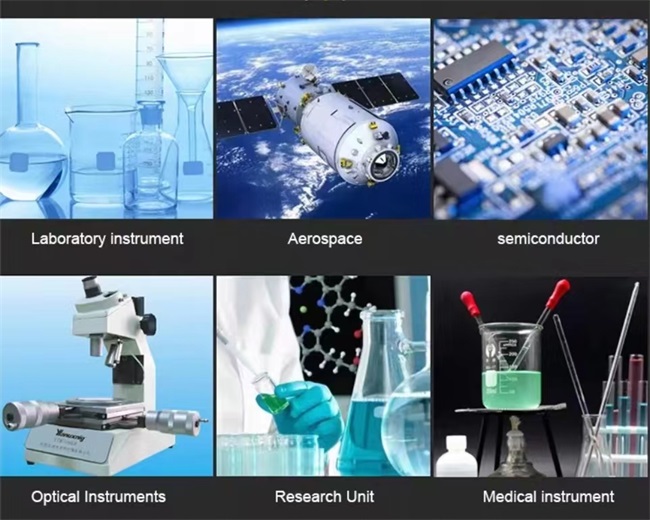
What Purity Grade Should You Specify for Your Industry?
Use the application-based guide below as a starting specification, then confirm with your process engineer and require incoming inspection data.
For semiconductor front-end processes such as diffusion, CVD, and wafer boats, the recommended minimum grade is high-purity fused quartz or synthetic silica, with Na below 1 ppm, K below 1 ppm, Fe below 1 ppm, and total metals below 10 ppm. Additional requirements include a defined bubble class, low OH for some processes, and tight dimensional precision.
For semiconductor lithography and photomask substrates, specify synthetic fused silica with metals in the ppb range and controlled OH and fluorine doping where applicable. Homogeneity, low birefringence, and excimer durability are additional requirements beyond chemical purity.
For UV and visible optics and windows, deep-UV applications call for synthetic fused silica, while visible-range optics can often use high-purity fused quartz. Check Fe, Cu, and Cr levels and match OH content to the operating wavelength, then verify transmission at the actual application wavelength rather than relying on a generic transmission curve.
For analytical laboratory work such as ICP-MS and acid digestion, high-purity fused quartz at ≥99.99% is the practical baseline. Verify low leachable metals with an acid extraction test and confirm low adsorption behavior for your analytes.
For chemical processing and reactors, high-purity fused quartz at ≥99.99% with controlled Na and Fe is appropriate. Ensure no visible bubbles at the process surface and confirm chemical compatibility and wall thickness uniformity.
For furnace tubes and thermal fixtures, high-purity fused quartz at ≥99.99% with low alkali metals helps resist devitrification. Request sag resistance data and thermal shock history where relevant.
For general industrial and lighting applications, industrial fused quartz at ≥99.9% is usually sufficient. Fe and Na should fall within an acceptable range, cost is the primary driver, and visual or optical requirements are secondary.
A practical procurement rule: do not accept “quartz glass” as a material description on a drawing. Specify the grade, the maximum impurity limits for at least Na, K, Fe, and Al, and the acceptance method—supplier COA, third-party test, or incoming ICP-MS verification.

How Can You Verify Purity Before and After Delivery?
Require a lot-specific certificate of analysis with element-by-element data, and establish an incoming inspection protocol appropriate to your risk level. For critical semiconductor or optical applications, third-party verification is strongly recommended.
Verification methods vary by element and detection limit. For ppm-level metallic impurities, ICP-MS or ICP-OES after digestion is standard. For surface contamination, acid extraction followed by ICP-MS can reveal handling contamination that bulk analysis misses. For OH content, FTIR is the common method. For bubbles and internal defects, visual inspection under high-intensity backlighting is routine, and critical optics may require interferometry or laser scattering.
A supplier with stable quality control should be able to provide the raw material source and purification method—natural crystal versus synthetic feedstock; a lot-specific impurity table with detection limits stated; bubble and striae classification if applicable; a dimensional inspection report; and traceability from raw material lot to finished part.
If a supplier responds to a purity inquiry with only “we use high-purity sand” and no numeric data, treat that as a quality risk.
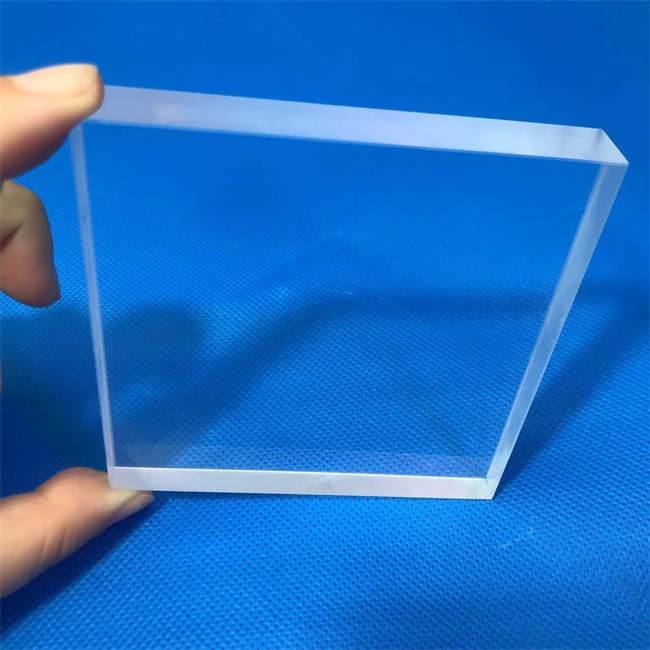
What About Custom Sizes and Non-Standard Parts—Does Purity Limit Customization?
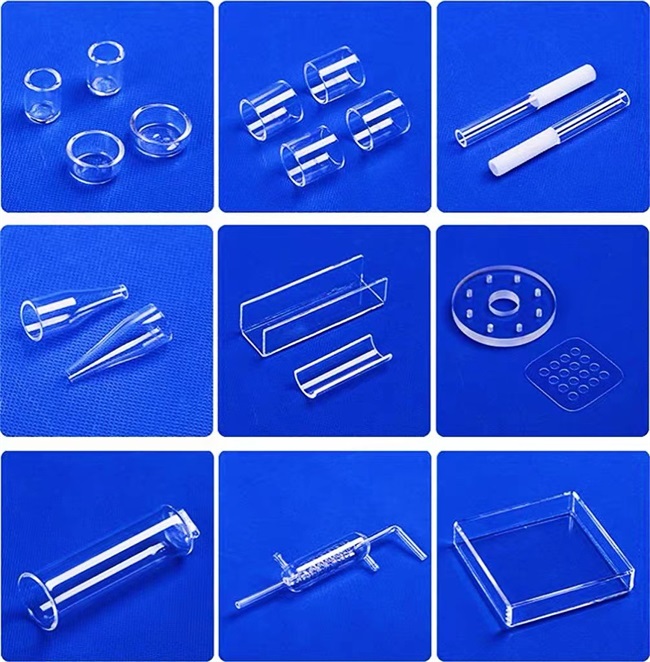
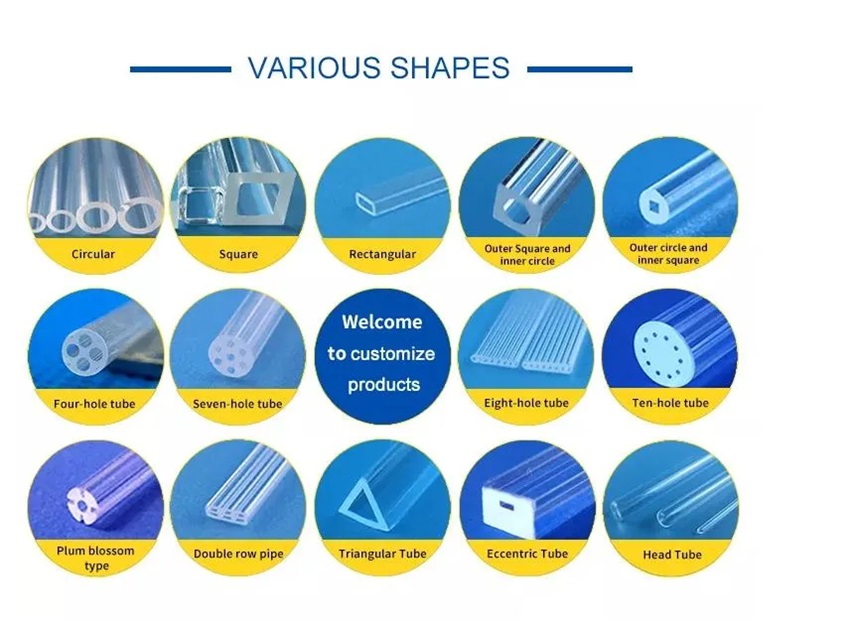
No. Purity grade and custom geometry are independent variables. A qualified quartz fabricator should be able to supply high-purity material in custom tubes, plates, rings, flanges, boats, and machined components per drawing or sample.
The more relevant question is whether the fabricator’s processes preserve purity. Cutting, grinding, drilling, and polishing can introduce contamination if coolant, tooling, or handling practices are not controlled. For semiconductor and laboratory parts, post-machining cleaning—acid etching, DI water rinsing, and drying in clean conditions—is essential. A fabricator who can machine a complex quartz boat but cannot document post-machining cleaning is only solving half the problem.
For custom requests, prepare a specification package that covers the material grade with numeric impurity limits, a drawing with critical dimensions, tolerances and surface finish requirements, the maximum continuous operating temperature and thermal cycling profile, any optical requirements such as transmission range, homogeneity and bubble class, cleaning and packaging requirements including cleanroom bagging and particle limits, and the documentation you expect, such as COA, dimensional report, and third-party inspection.
Low-MOQ or prototype runs are feasible for most custom quartz parts, but expect tooling and setup costs to be amortized differently than in high-volume orders. A transparent supplier will quote prototype and production pricing separately rather than hiding setup charges.
Common Mistakes in Quartz Purity Specification
The most common mistakes are over-specifying purity for non-critical parts, under-specifying for high-temperature or electrical applications, and accepting vague material descriptions without numeric limits.
Specifying “high purity” without numbers is the most frequent error. “High purity” is a marketing phrase, not a specification. Define maximum Na, K, Fe, and total metals. For semiconductor use, also define bubble class and OH range.
Using synthetic quartz where fused quartz is adequate wastes money. Synthetic silica costs significantly more. Unless you need ppb-level metals, deep-UV transmission, or excimer durability, high-purity fused quartz may meet your needs at lower cost.
Ignoring surface condition undermines material quality. A high-purity part with grinding residue or handling contamination can perform worse than a lower-purity part with a clean, properly etched surface. Specify cleaning and packaging.
Assuming one grade fits all parts in an assembly is another common oversight. A semiconductor furnace assembly may use high-purity quartz for the process tube and a lower grade for structural supports that do not see the wafer environment. Optimize per component.
Not qualifying the fabricator’s process leaves a hidden risk. Even certified raw material can be contaminated by poor machining, handling, or packaging. Audit the fabricator’s cleaning and traceability practices, not just their material certificate.
Why Work With a Quartz Manufacturer Who Understands Application-Specific Purity?
Because purity is a system property—raw material, melting method, fabrication process, cleaning, and packaging all contribute. A supplier who only sells “quartz glass” cannot help you solve contamination, sag, or transmission problems when they appear.
A qualified quartz partner should help you match grade to application instead of defaulting to the most expensive option, provide numeric impurity data lot by lot rather than a one-time brochure, fabricate custom geometry from tube, rod, plate, or ingot without compromising surface cleanliness, support prototype and low-volume runs so you can qualify a design before committing to production, document traceability from raw material to finished part, and meet delivery schedules for both standard and custom items with realistic lead times rather than optimistic promises.
For buyers facing tight timelines on non-standard quartz parts, the practical advantage of a source manufacturer is fewer handoffs: the same facility that melts or imports the certified material also machines, cleans, inspects, and packages the finished component. That reduces the risk of contamination introduced by subcontractors and makes accountability clearer when a lot fails incoming inspection.
Frequently Asked Questions (FAQ)
What is the difference between fused quartz and synthetic quartz glass?
Fused quartz is made by melting natural quartz crystal or high-purity silica sand. Synthetic quartz glass is made from silicon-containing chemical precursors such as SiCl₄, resulting in lower metallic impurities—typically ppb rather than ppm—and more consistent optical properties. Synthetic is preferred for lithography, deep-UV optics, and critical semiconductor applications.
Is 99.99% SiO₂ purity good enough for semiconductor diffusion tubes?
For many mature-node and support applications, yes, provided Na, K, and Fe are individually specified and controlled, and bubble class is acceptable. For advanced nodes and 12-inch wafer processes, synthetic or ultra-high-purity fused quartz with lower total metals is increasingly preferred.
Does higher purity quartz glass cost significantly more?
Yes. Synthetic silica can cost several times more than industrial fused quartz per kilogram. High-purity fused quartz sits between them. The right approach is to specify the minimum purity that meets your process requirements, not the highest available.
Can you provide custom quartz parts with low MOQ?
Yes. For prototype and qualification runs, low-MOQ or sample orders are typically feasible. Pricing will reflect setup and tooling costs, but it allows you to validate design and material before scaling.
How do I specify OH content for my application?
For deep-UV transmission below 250 nm, high-OH synthetic quartz, roughly 1000–2000 ppm, is generally preferred. For IR transmission or applications where OH absorption bands interfere, specify low-OH grade. If OH content is not critical to your process, standard fused quartz OH levels of 100–300 ppm are usually acceptable.
What is the maximum operating temperature of high-purity quartz glass?
Continuous service is typically up to 1100°C–1200°C, with short-term excursions to 1300°C–1400°C depending on grade and geometry. Above these temperatures, devitrification and sag become significant risks regardless of purity.
Can quartz glass be machined into complex shapes without losing purity?
Yes, but post-machining cleaning is critical. Grinding and cutting introduce particulate and potential metallic contamination. A qualified fabricator will use controlled coolants, dedicated tooling, and acid/DI water cleaning before packaging.
What documentation should I request with a quartz part order?
At minimum: a lot-specific COA with impurity data, a dimensional inspection report, and material grade certification. For critical applications, request cleaning records, bubble and striae classification, and third-party test reports.
Is quartz glass resistant to all acids?
No. Quartz is highly resistant to most acids but is attacked by hydrofluoric acid and hot concentrated phosphoric acid. Even high-purity quartz will etch in HF. Confirm chemical compatibility for your specific process.
How does purity affect quartz glass transmission?
Transition metals, especially iron, absorb in the UV range. For UV optics, low Fe and controlled OH are essential. For visible and IR applications, purity requirements are generally less stringent unless fluorescence or scattering is a concern.
Can you match the purity and dimensions of a sample part we already use?
Yes. Reverse-engineering from a sample is standard practice for custom quartz fabrication. Provide the sample plus any known material or tolerance requirements, and the fabricator can propose a material grade and manufacturing plan.
What lead times should I expect for custom high-purity quartz parts?
Standard tubes and plates may ship from stock in days to a few weeks. Custom machined parts typically require two to six weeks depending on complexity, material availability, and cleaning requirements. Rush options may be available at premium cost.
Do you export globally, and what shipping documentation do you provide?
Yes. Export documentation typically includes commercial invoice, packing list, certificate of origin, and material certificates. For sensitive applications, cleanroom packaging and desiccant protection can be specified.
What is the most important purity parameter for high-temperature furnace tubes?
Alkali content, meaning Na and K, is often the most critical because alkalis lower high-temperature viscosity and accelerate devitrification. Fe and Al also matter but usually at slightly higher thresholds. Request sag and devitrification test data if your process runs near the upper temperature limit.
How do I know if my supplier’s “high-purity” claim is reliable?
Ask for lot-specific numeric data with detection limits, not a generic brochure. Request a sample lot for incoming inspection before committing to production. A supplier confident in their process will provide data without hesitation.

Luverre Quartz manufactures and sells a wide range of high quality quartz glass, including quartz tubes, quartz plates, quartz rods, quartz windows, quartz crucibles, quartz boats, quartz flanges, quartz beakers, quartz glass instruments, and more. We can meet all kinds of customized requirements for quartz glass products.
