Industrial quartz products fall into two broad categories: quartz glass products (tubes, plates, rods, crucibles, flanges, rings, windows, discs, boats, and custom machined parts) and high-purity quartz raw materials and crystal components. The former are made from fused quartz and are valued for high-temperature resistance, low thermal expansion, high chemical purity, and optical transmission—serving semiconductor, photovoltaic, chemical, optical, and laboratory applications. The latter are used for wafer handling, high-temperature diffusion, precision optical transmission, and frequency control. For buyers, the key question is not "which quartz is best," but whether purity grade, hydroxyl content, dimensional tolerance, and operating temperature match the specific equipment and process conditions.
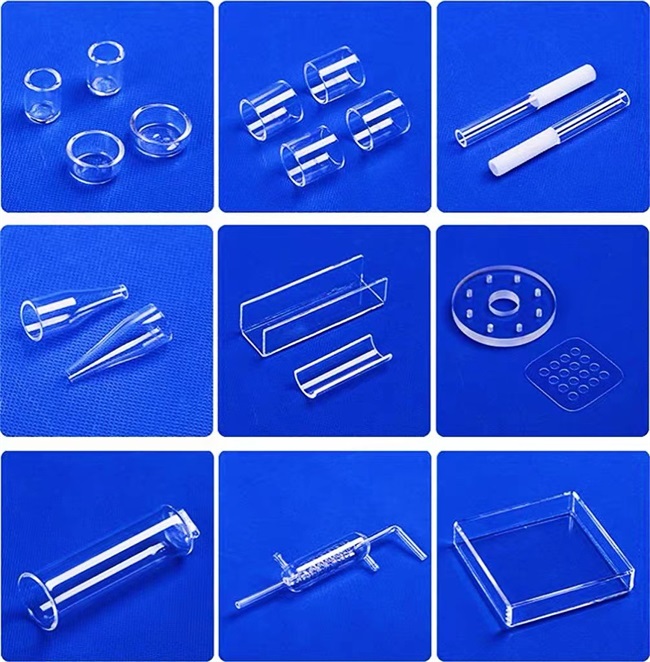
Common Industrial Quartz Product Types and Their Functions
Quartz tubes and rods are fundamental consumables in semiconductor diffusion, oxidation, and thin-film deposition. Quartz tubes typically serve as reaction chambers or gas channels, requiring uniform wall thickness, thermal shock resistance, and low outgassing. Quartz rods are often used as support structures or as stock for secondary machining. Electrically fused transparent quartz tubes have low hydroxyl content (roughly 1–10 ppmw), making them suitable for moisture-sensitive high-temperature processes—but metallic impurity control depends on raw material purity.
Quartz plates, discs, and windows provide light transmission, isolation, or support in optical and semiconductor equipment. For optical-grade quartz windows, the material choice must distinguish fused quartz from synthetic quartz (fused silica): synthetic silica offers superior transmission in the deep-UV range (below 260 nm) with virtually no fluorescence, making it suitable for lithography and precision inspection. Fused quartz from natural raw materials is more cost-effective in the visible-to-near-IR range, but may show localized transmission variation due to micro-bubbles or impurities.
Quartz crucibles and boats come into direct contact with high-temperature melts or wafers. Photovoltaic-grade crucibles must withstand silicon melt attack above 1400°C, and their service life depends on the density of the high-purity inner coating and bubble control. Semiconductor diffusion boats require dimensional stability and low particle shedding, typically made from high-purity quartz with low alkali content to prevent sodium and potassium ions from migrating into wafers at high temperature.
Quartz flanges, rings, and custom machined parts are precision structural components. Flanges seal connections between quartz tubes; face flatness and bore tolerance directly affect vacuum or atmosphere sealing. Rings are often used for etch chamber components or wafer positioning—their ID/OD tolerances and surface roughness must match equipment slots, since micron-level deviation can cause assembly stress or particle contamination.

Key Parameters for Selecting Quartz Products by Application
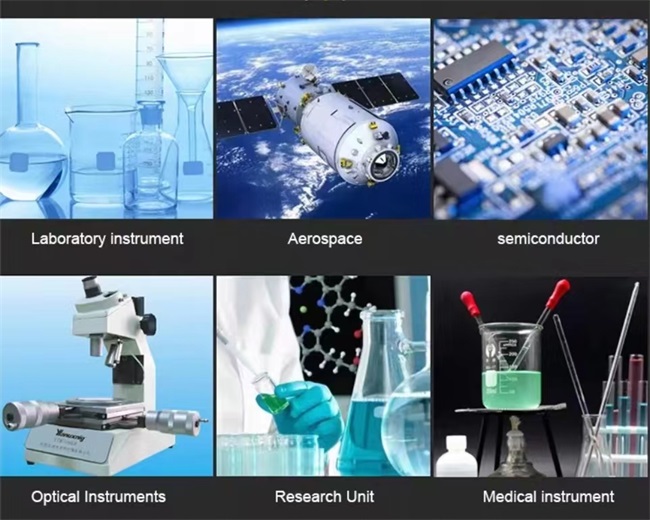
Semiconductor front-end processes are highly sensitive to quartz purity and outgassing behavior. Quartz parts for 300 mm wafer processing typically require metallic impurities at the ppb level and controlled bubble/inclusion counts. When specifying, distinguish "electrically fused transparent quartz" from "synthetic quartz": synthetic silica offers higher purity and no bubbles, suitable for critical etch or lithography steps; electrically fused quartz offers good thermal stability at lower cost and can be used for diffusion tubes, furnace tubes, and other high-volume consumables.
High-temperature heat treatment and industrial furnaces prioritize thermal expansion coefficient and thermal shock resistance. Quartz glass has a thermal expansion coefficient of approximately 0.5×10⁻⁶/K, far lower than ordinary glass and ceramics, so it resists cracking under rapid heating and cooling. Note, however, that continuous service temperature typically does not exceed 1100°C, with short-term limits around 1250–1300°C. Actual service life also depends on support structure, heating rate, and surface contamination (alkali metal deposits accelerate devitrification).
Optical and UV applications require a trade-off between "natural fused quartz" and "synthetic fused silica." If the equipment involves excimer lasers, UV spectroscopy, or deep-UV lithography, specify synthetic silica, whose intrinsic absorption in the 193–250 nm range is extremely low. For visible or near-IR windows only, natural quartz meets requirements with shorter lead times and lower cost.
Chemical and laboratory applications focus on chemical stability and thermal stability. Quartz offers excellent resistance to most acids (except hydrofluoric acid and hot phosphoric acid), but surfaces may devitrify or lose transparency when exposed to alkaline solutions or high-temperature steam. For cleaning baths or reaction vessels, confirm whether the inner surface is fire-polished or acid-washed to reduce liquid retention and particle residue.
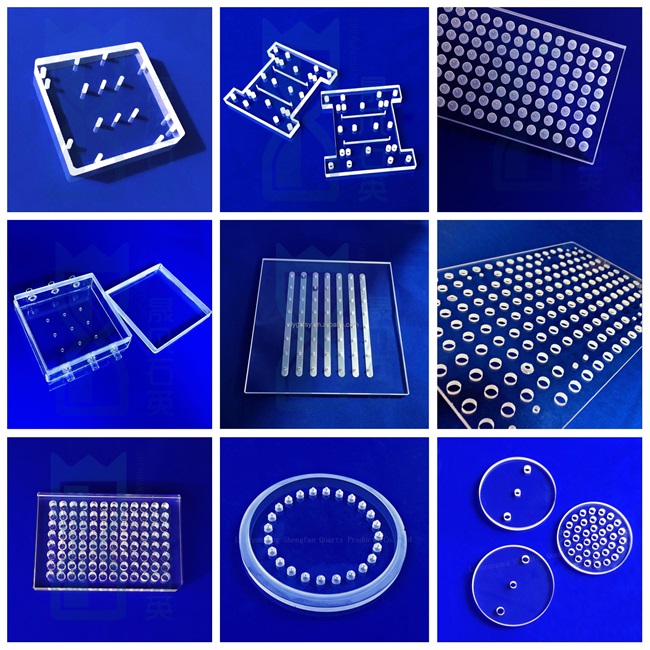
Specification Elements to Define in Custom Machining
When ordering custom quartz parts from drawings, buyers and engineers should lock down the following parameters at the inquiry stage to avoid repeated sampling:
- Material grade and purity: Specify natural quartz vs. synthetic silica, and the upper limits for total metallic impurities (e.g., Al, Na, K, Fe in ppm). Different grades differ significantly in devitrification tendency at high temperature and in optical cutoff wavelength.
- Critical dimensions and tolerances: For tubes, specify OD, ID, wall thickness, and concentricity; for plates, thickness tolerance and parallelism; for flanges, sealing-face flatness and bolt-hole position. Precision-machined quartz tolerances are typically expressed in hundredths or thousandths of a millimeter, but not every dimension needs the highest precision—tighten requirements only on mating and sealing surfaces.
- Surface condition: Specify transparent, frosted, or fire-polished. Fire polishing reduces surface micro-cracks and particle shedding risk but may introduce local thermal stress; frosted surfaces aid diffusion or masking but are harder to clean.
- Annealing and stress requirements: Large or thick-walled quartz parts need annealing after machining to relieve residual stress; otherwise they may deform or crack during high-temperature use. Ask suppliers whether they provide stress inspection or polarized-light examination reports.
- Cleaning and packaging level: Semiconductor quartz parts typically require ultrasonic cleaning and double-bagged cleanroom packaging; general industrial parts can accept standard cleaning. Cleaning standards directly affect post-incoming yield and should be written into the order.
Common Judgment Points When Purchasing Quartz Products
Do not decide based on the phrase "high purity" alone. Different applications define "high purity" differently: PV crucibles focus on alkali metals and boron; semiconductor diffusion tubes focus on sodium, potassium, iron, and total heavy metals; optical parts focus on hydroxyl and bubble density. Require suppliers to provide test data specific to your application (e.g., ICP-MS impurity reports, bubble/inclusion grade descriptions) rather than vague "99.99%" claims.
Lead time must match machining capability. Standard tubes, rods, and plates are often stocked with short lead times; flanges, custom boats, large-diameter windows, or complex welded assemblies require tooling or CNC programming and may take significantly longer. Providing a sketch or STEP file at inquiry, and clarifying whether alternative materials or partial shipments are acceptable, helps suppliers give an executable production schedule.
Small-batch custom work and high-volume production have different cost structures. For single-piece or small-batch orders, programming, fixturing, and inspection costs dominate; for volume orders, material utilization and machining efficiency take over. If the project is in R&D, prioritize suppliers willing to take small-batch trial runs, then negotiate volume pricing and tooling amortization once drawings are frozen.

FAQ
Are "quartz glass" and "fused quartz" the same thing?
They are often used interchangeably, but strictly speaking "quartz glass" is a general term covering both fused quartz made from natural quartz sand and synthetic quartz (fused silica) made from synthetic silicon sources. Performance differences stem mainly from raw material and process—confirm the specific material rather than relying on the name alone.
What is the maximum temperature quartz parts can withstand?
Continuous service typically does not exceed 1100°C, with short-term exposure up to 1250–1300°C. Actual temperature capability depends on support method, heating rate, surface contamination, and quartz type. Synthetic silica has a softening point close to that of natural quartz but fewer impurities, slightly reducing devitrification risk at high temperature.
Can you reverse-engineer from a sample?
Yes. When a physical sample is provided, the supplier can measure and produce drawings for confirmation. Note that the sample itself may be worn or deformed—provide measured values for critical mating dimensions or original equipment interface parameters to calibrate the measurement baseline.
Why do some quartz windows cost much more?
Price differences come mainly from material (synthetic silica vs. natural quartz), UV cutoff requirements, surface figure accuracy (e.g., λ/10 vs. standard window), and whether coating is required. Deep-UV-grade synthetic quartz windows involve far higher raw material cost and processing/inspection time than standard industrial windows.
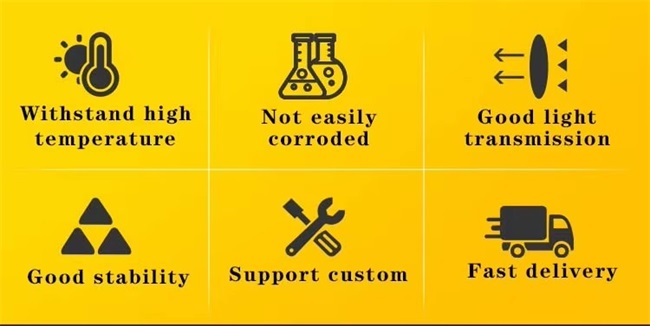
Quartz product selection is essentially a three-way balance of purity, thermal performance, and dimensional precision. If you are sourcing a replacement or custom quartz part for a specific piece of equipment, provide the operating temperature, contact medium, critical dimensions, and annual usage—we can then recommend a material and give an initial assessment of machining feasibility.
Luverre Quartz manufactures and sells a wide range of high quality quartz glass, including quartz tubes, quartz plates, quartz rods, quartz windows, quartz crucibles, quartz boats, quartz flanges, quartz beakers, quartz glass instruments, and more. We can meet all kinds of customized requirements for quartz glass products.