
T: +86-518-85528012
E: nick@luverrequartz.com
E: nick@luverrequartz.com
1st floor Runlian industrial center No. 116 QuFeng Rd., Haizhou Economic and technological development zone Lianyungang City, Jiangsu Province, China 222062
Views: 0 Author: Site Editor Publish Time: 2026-07-03 Origin: Site


Whether quartz plates crack during drilling depends primarily on the machining process, equipment precision, and the physical properties of the material itself. As a highly hard and brittle material, using standard drill bits or applying excessive force during drilling can easily lead to chipping or cracking due to thermal stress concentration. However, by selecting industrial-grade diamond drill bits, implementing continuous water cooling, and allowing for scientifically calculated safety margins, it is entirely possible to achieve high-precision, damage-free drilling that ensures the structural stability of the finished product.

From the user’s perspective, we fully understand that in precision manufacturing and engineering applications, the machining quality of quartz slabs directly determines the yield rate and service life of the final product. We are committed to providing you with a one-stop solution—from drawings to finished products—to thoroughly resolve challenges such as machining cracks, excessive dimensional tolerances, and performance degradation under extreme conditions. Through customized secondary processing services, we help clients eliminate cumbersome secondary processing steps, significantly reducing material waste and production time costs, and ensuring that every quartz plate perfectly meets your core application requirements.

Technical Analysis of Crack-Prevention Techniques for Quartz Plate Drilling
Due to their high Mohs hardness and strong wear resistance, quartz plates do indeed present certain challenges during processing. To ensure drilling without cracking, we strictly adhere to the following objective standards and process procedures during machining:
Core Cutting Tools and Cooling Systems: We have abandoned traditional carbide drill bits in favor of industrial diamond hollow drill bits. A continuous water drip or coolant circulation system is employed throughout the machining process. The water film carries away cutting debris and prevents the diamond segments from overheating, thereby avoiding high-temperature damage to the material’s internal structure or thermal shock cracking.
Scientific Hole Placement and Edge Margin Control: When designing hole locations, the safety margin between the hole and the edge of the slab must be greater than or equal to 80 mm. For slabs with an edge margin of less than 200 mm or a hole length exceeding 500 mm, we reinforce the structure at the bottom using quartz strips or reinforcement rods to effectively distribute stress and prevent cracking during processing or subsequent use.
Corner Stress Concentration Prevention Process: When machining square or irregular-shaped holes, forceful cutting at right angles is strictly prohibited. All four corners of the holes must first be pre-drilled with circular holes having a radius of no less than R10 mm (R25 mm or greater is recommended for countertops), followed by slow cutting using wire cutting or CNC equipment to completely eliminate the risk of stress concentration caused by sharp corners.
Precision Equipment and Flexible Feed: Cutting is performed using CNC machining centers and high-precision waterjet equipment. During operation, maintain a low speed (500–1,000 rpm) with gentle, continuous downward pressure. Cutting all the way through in a single pass is strictly prohibited; typically, the process is performed in incremental steps, with pressure reduced before penetration to prevent bottom chipping.

Full-Range Customization Services and Core Product Value
We possess comprehensive, end-to-end customization capabilities across the entire industrial chain. Our workshop is equipped with CNC cutting machines, double-sided grinders, precision drilling equipment, and automatic annealing furnaces.
Full Specification Coverage: We support customization for thicknesses ranging from 2 mm to 30 mm and any non-standard dimensions for length and width. Whether it’s transparent quartz slabs, milky white quartz slabs, or frosted and perforated stepped panels, we can deliver them flawlessly.
Advanced Processing Matrix: In addition to basic drilling, we offer a full suite of advanced processing procedures, including slotting, countersinking, polishing, sandblasting, and custom-shaped cutting. Small-batch samples are delivered in 3–7 days, while large-scale production runs are completed in 7–15 days, accommodating varying procurement volumes from small and medium-sized R&D enterprises to large manufacturing plants.
Uncompromising Quality Control: Before shipment, finished products undergo a comprehensive quality inspection process covering light transmittance, thickness tolerance, stress testing, and temperature resistance testing. This ensures high consistency in parameters across every batch, significantly reducing defect rates in downstream production.

Why Choose Us: Addressing Application Challenges Head-On
In applications such as aerospace, semiconductors, precision optics, and high-end building materials, quartz materials face severe challenges including extreme temperatures, intense corrosion, and high-frequency vibrations. Our high-purity quartz substrate (SiO₂ content ≥99.9%) features an extremely low coefficient of thermal expansion and exceptional thermal shock resistance. Through our specialized crack-resistant drilling process, we not only preserve the material’s inherent high-temperature resistance (up to 1730°C) and resistance to strong acid and alkali corrosion but also ensure the structural integrity and optical stability of complex components under extreme operating conditions, providing customers with truly game-changing material solutions.
Customer Application Cases
Case 1: Precision Quartz Windows for Semiconductor Equipment
Requirement: The customer needed to machine an array of 0.4 × 5 mm square through-holes on a 12 mm-thick quartz glass plate, with a hole pitch of only 1.2 mm and a precision requirement of ±0.03 mm. Previously, multiple suppliers had failed to deliver due to severe chipping and cracking issues.
Solution: We employed an optimized laser processing technique combined with a gradient power strategy to strictly control the heat-affected zone.
Result: The part passed the customer’s acceptance inspection on the first attempt, with smooth, crack-free hole walls and precision fully meeting specifications. Customer feedback: “This solved a technical bottleneck we had long been unable to overcome.”
Case Study 2: Deep Drilling of Large-Size Quartz Substrates for Optical Instruments
Requirement: An optical equipment manufacturer needed to machine Φ3×65 mm through-holes for cooling in a 100×100×30 mm quartz plate, with requirements for no visible cracks on the inner walls and a surface roughness of Ra < 0.8 μm.
Solution: We employed an ultrasonic-assisted drilling process equipped with a high-pressure central water jet system to ensure smooth chip removal.
Results: The processing time per hole was reduced from 26 minutes using traditional methods to 3 minutes and 17 seconds, representing an 85% increase in efficiency, while the hole wall quality exceeded customer expectations.
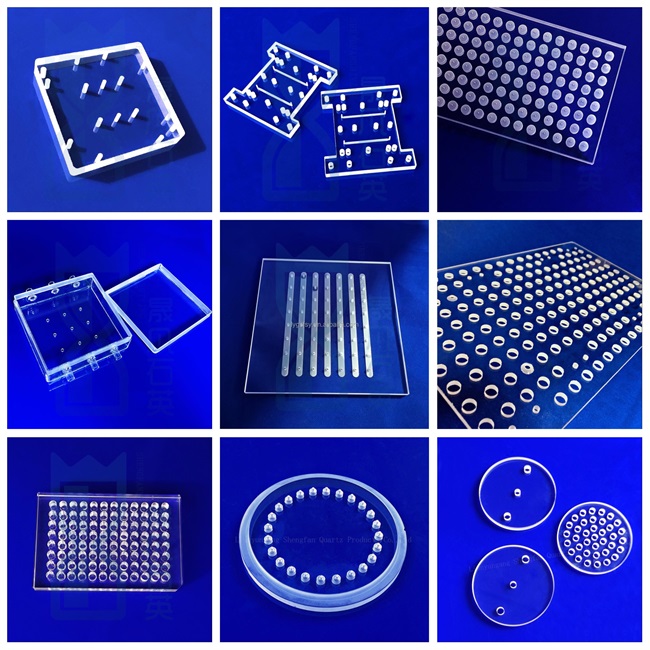
Whether you need laboratory-grade precision quartzware or industrial-grade, large-sized, high-temperature-resistant slabs, we can provide you with tailor-made machining services. Feel free to contact us at any time to receive a customized solution and quote for your quartz products!
Do you have specific drawings or dimensional requirements for drilling holes in quartz slabs? Please send them to me directly, and I will help you evaluate the machining solution and provide a quote.
Luverre Quartz manufactures and sells a wide range of high quality quartz glass, including quartz tubes, quartz plates, quartz rods, quartz windows, quartz crucibles, quartz boats, quartz flanges, quartz beakers, quartz glass instruments, and more. We can meet all kinds of customized requirements for quartz glass products.
