T: +86-518-85528012
E: nick@luverrequartz.com
E: nick@luverrequartz.com
1st floor Runlian industrial center No. 116 QuFeng Rd., Haizhou Economic and technological development zone Lianyungang City, Jiangsu Province, China 222062
 |


Softening point 1730 ℃ JGS1 quartz glass
JGS1 quartz glass is a synthetic fused silica material with the highest transmissivity in the far ultraviolet band, and its softening point is up to 1730 ℃
LUVERRE quartz
99.99%
Inner with Vacuum PVC bag and then wrapped with air bubble film, outer with wooden box.
as per customer's requirement
Softening point 1730 ℃ JGS1 quartz glass
JGS1 quartz glass is a synthetic fused silica material with the highest transmissivity in the far ultraviolet band, and its softening point is up to 1730 ℃, showing excellent stability and transmittance in extreme high temperature and deep ultraviolet optical applications. As a professional custom quartz product manufacturer, Luverre Quartz uses high-purity JGS1 as the substrate to provide precision machining and customized solutions for global customers, meeting the stringent requirements for material ultimate performance in cutting-edge fields such as semiconductor lithography, high-energy lasers, aerospace, etc.
Frequently Asked Questions (FAQ)
Q: What does the "softening point 1730 ℃" of JGS1 quartz glass mean?
Answer: The softening point refers to the temperature at which a material begins to undergo plastic deformation when heated. The softening point of 1730 ℃ means that JGS1 can maintain shape and size stability in extremely high temperature environments, far exceeding the temperature resistance limit of ordinary optical glass or ordinary quartz materials, and is particularly suitable for optical windows, load-bearing components, or high-temperature chamber applications in high-temperature processes.
Q: What is the main difference between JGS1 and ordinary quartz glass?
Answer: JGS1 is synthetic fused silica, with very low metal impurity content (total metal impurity<1ppm), high transmittance in deep ultraviolet band (185nm-250nm), and no "ultraviolet absorption peak". Ordinary quartz glass exhibits significant absorption in the ultraviolet region and cannot meet the requirements of deep ultraviolet optical systems.
Q: What shapes can JGS1 be processed into? Can I customize the size?
Answer: Sure. We provide full process customization from raw materials to precision finished products, including circular/square optical windows, lenses, prisms, quartz rings, shaped structural components, optical elements with steps or holes, etc. The size range is wide, with a minimum machining tolerance of ± 0.01mm, meeting the needs of scientific research and industrial mass production.
Q: Will JGS1 crystallize at high temperatures?
Answer: JGS1 has excellent anti crystallization properties due to its high purity and synthesis process. In long-term high-temperature use (such as 1100 ℃ -1300 ℃), compared with ordinary fused silica, the crystallization tendency is extremely low, which can maintain long-term stability of optical properties and mechanical strength.

What core needs can the product solve for you?
-Deep ultraviolet optics requirements: In DUV lithography, ultraviolet laser, spectral analysis and other scenarios, provide a transmittance of over 90% in the 185nm-250nm band to ensure the efficiency and accuracy of the optical system.
-Extreme high temperature stability requirements: In high temperature processes such as diffusion furnaces, CVD, and high temperature testing, solve the problems of softening deformation and light transmittance attenuation of ordinary materials.
-Ultra low pollution risk requirement: To avoid process pollution and yield loss caused by impurity precipitation in high cleanliness applications such as semiconductors and biomedicine.
-Precision size and complex shape requirements: Get rid of the limitations of standard parts and obtain irregular, thin-walled, large-sized quartz components that perfectly match the equipment or optical path design.

Core features and advantages of the product
Material Performance - Ultimate Index of JGS1
Softening point: 1730 ℃
Annealing point: 1210 ℃
Operating temperature (long-term): 1100 ℃
UV transmittance (185nm): ≥ 85% (10mm thickness)
Visible light transmittance: ≥ 92%
Uniformity of refractive index: ≤ 5 × 10 ⁻⁶
Total amount of metal impurities:<1ppm
JGS1 has an extremely low birefringence and a thermal expansion coefficient of only 5.5 × 10 ⁻⁷/℃. It has excellent thermal shock resistance and can maintain structural integrity under rapid temperature changes.
2. Precision machining capability
-Optical cold processing: grinding, polishing, coating, surface shape accuracy can reach λ/10 (632.8nm), surface roughness<0.5nm.
-Mechanical processing: CNC molding, drilling, chamfering, sanding, slotting, to meet complex structural requirements.
-Cleanliness treatment: Class 100 cleanroom cleaning and packaging, directly applicable to semiconductor production lines.
3. Customized services
We support:
-Size customization: diameter 5mm -600mm, thickness 0.5mm -100mm.
-Shape customization: circular, rectangular, trapezoidal, irregular contour, with steps, through holes, and positioning edges.
-Surface condition: double-sided polishing, single-sided polishing, frosted surface, local optical surface, coated with anti reflective film/spectral film/reflective film.
-Batch flexibility: From single piece trial production to bulk supply, supporting research institutions' small batch and high-frequency iteration needs.

Application problems that the product can solve
In practical applications, customers often encounter the following difficulties:
-Insufficient transmittance of deep ultraviolet light path: Ordinary quartz absorbs heavily in the deep ultraviolet band, resulting in weak signals and low exposure efficiency. JGS1 maintains high transmittance at key wavelengths such as 193nm and 248nm, making it an ideal choice for lithography machines, excimer lasers, and UV curing equipment.
-Optical component failure under high temperature: In high-temperature measurement, laser processing, and high-temperature reaction observation, ordinary window materials may cause data distortion due to thermal deformation or decreased transmittance. JGS1 maintains excellent optical performance and dimensional stability above 1000 ℃ due to its softening point of 1730 ℃.
-Impurity contamination leads to process failure: In semiconductor diffusion furnaces and epitaxial equipment, trace metal precipitation from quartz components can cause device leakage or reduced lifespan. JGS1 ultra-high purity effectively eliminates pollution sources.
-Non standard sizes cannot match imported equipment: imported equipment has long lead times and high prices for original spare parts. We can accurately replicate or optimize the design based on device interfaces and optical path parameters to achieve complete replacement.

Customer Application Case (Anonymous)
Case 1: A semiconductor lithography equipment manufacturer - quartz window for 193nm stepper lithography machine
Customer requirement: JGS1 optical window with a diameter of 320mm, used for 193nm deep ultraviolet light path system, requires transmittance ≥ 90% (193nm), surface shape accuracy λ/10, surface roughness<0.5nm, and long-term exposure to high-energy ultraviolet radiation without producing color centers.
We provide full process control from raw material screening to ultra precision polishing, using ion beam assisted polishing technology, with a final transmittance of 91.5% and surface shape error RMS ≤ λ/12. The product has passed a 2000 hour high-energy ultraviolet aging test, with a transmittance attenuation of less than 0.5%.
Case 2: A Aerospace Payload Research Institute - High Temperature Ultraviolet Detection Window
Customer requirement: Used for a certain model of satellite payload, it is required to maintain stable transmittance in the deep ultraviolet band (250nm-300nm) under temperature alternating environment from -60 ℃ to+800 ℃, with a window size of 150mm × 80mm × 15mm and a rectangular shaped installation flange.
We use JGS1 material, which is precision CNC molded and double-sided polished, and coated with a high-temperature resistant anti reflective film on the surface. In third-party environmental testing, after 100 cycles of high and low temperature, the transmittance of the product changed by less than 1% without cracking or delamination.
Case 3: A High Power Excimer Laser Manufacturer - Laser Output Window
Customer problem: The original JGS1 import window has a delivery time of up to 12 weeks, and the price has been increasing year by year. The output energy of the laser can reach up to 500mJ/pulse, which requires a very high threshold for the window's resistance to laser damage.
We offer an alternative solution by optimizing the polishing and cleaning processes to increase the laser damage threshold to ≥ 25J/cm ⊃2; (248nm, 10ns), which is superior to the original factory specifications. At the same time, the delivery time will be reduced to 4-6 weeks, resulting in a 35% decrease in individual unit costs.
Case 4: Observation Window of High Temperature and High Pressure Reactor in a Physics Laboratory of a Certain University
Customer requirement: Used for supercritical fluid experiments, with a working temperature of 900 ℃ and a pressure of 30MPa, requiring real-time ultraviolet spectroscopy acquisition. The original sapphire window had insufficient UV transmittance and high cost.
We have customized JGS1 circular windows with a thickness of 25mm, using double-sided precision polishing and pressure resistant structural design. In practical use, the window can withstand 900 ℃/30MPa working conditions for more than 500 hours, and the UV transmittance meets the spectral acquisition requirements, with a cost only one-third of the sapphire solution.
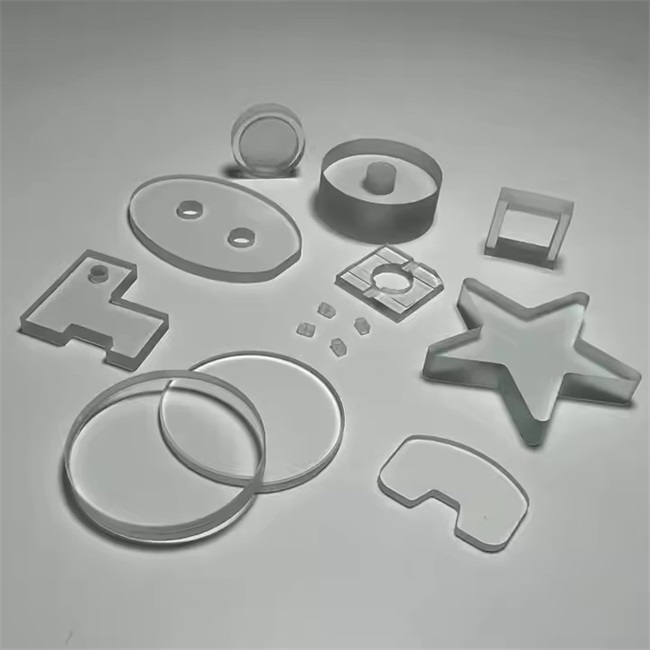
Whether it's semiconductor lithography, high-energy lasers, aerospace, or high-temperature optics and scientific research experiments, we can provide you with one-stop JGS1 quartz glass customization services from material selection, precision machining to coating testing. Welcome to provide your drawings or usage requirements, and we will match you with the optimal process solution and delivery time.
Luverre Quartz manufactures and sells a wide range of high quality quartz glass, including quartz tubes, quartz plates, quartz rods, quartz windows, quartz crucibles, quartz boats, quartz flanges, quartz beakers, quartz glass instruments, and more. We can meet all kinds of customized requirements for quartz glass products.


